
Delhi | July 3, 2025: As record-breaking temperatures sweep across southern Europe this week, killing at least eight people and crippling critical infrastructure, the warning signs for India are unmistakable. While Portugal saw the mercury touch an unprecedented 46.6°C, Italy issued red alerts in 18 cities and Switzerland shut down a nuclear reactor to avoid overheating. These are not isolated events. They are symptoms of an accelerating global crisis—and India may be the next epicentre.
For a country where large parts of the population already endure 45°C summers without access to cooling, the lesson from Europe is chilling in its urgency. India is not just at risk. It is perilously close to a tipping point.
The current European heatwave, one of the worst in decades, is being driven by a persistent “heat dome” – a high-pressure zone that traps hot air and bakes the land below. ESA satellite data reveals land surface temperatures over 55°C in parts of southern Europe—much higher than the ambient air temperatures recorded on weather stations.
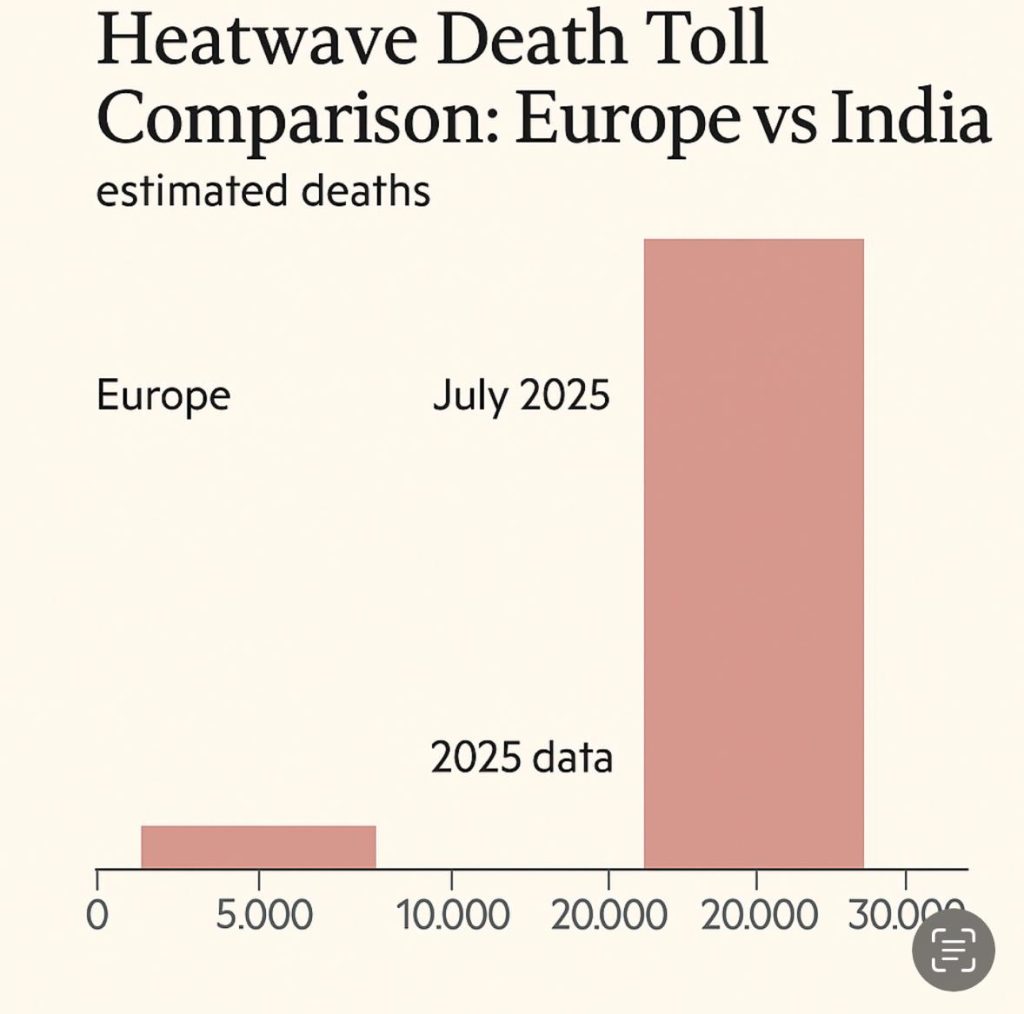
India, of course, has already felt the brunt of such heat. In the summer of 2024, temperatures in parts of Rajasthan, Uttar Pradesh, and Telangana hovered near 50°C. Delhi breached 46°C for five consecutive days. Across 17 states, over 40,000 heatstroke cases were officially recorded.
What separates India’s crisis from Europe’s, however, is scale and vulnerability. Europe, for all its suffering, has institutional buffers—strong healthcare, cooling infrastructure, and emergency preparedness. India, with its dense population, informal workforce, and poor urban planning, is exposed on all fronts.
India’s climate vulnerability is deeply intertwined with its social and economic structures. Over 80% of our population lives in districts considered highly exposed to hydro-meteorological hazards. Yet the burden is not shared equally.
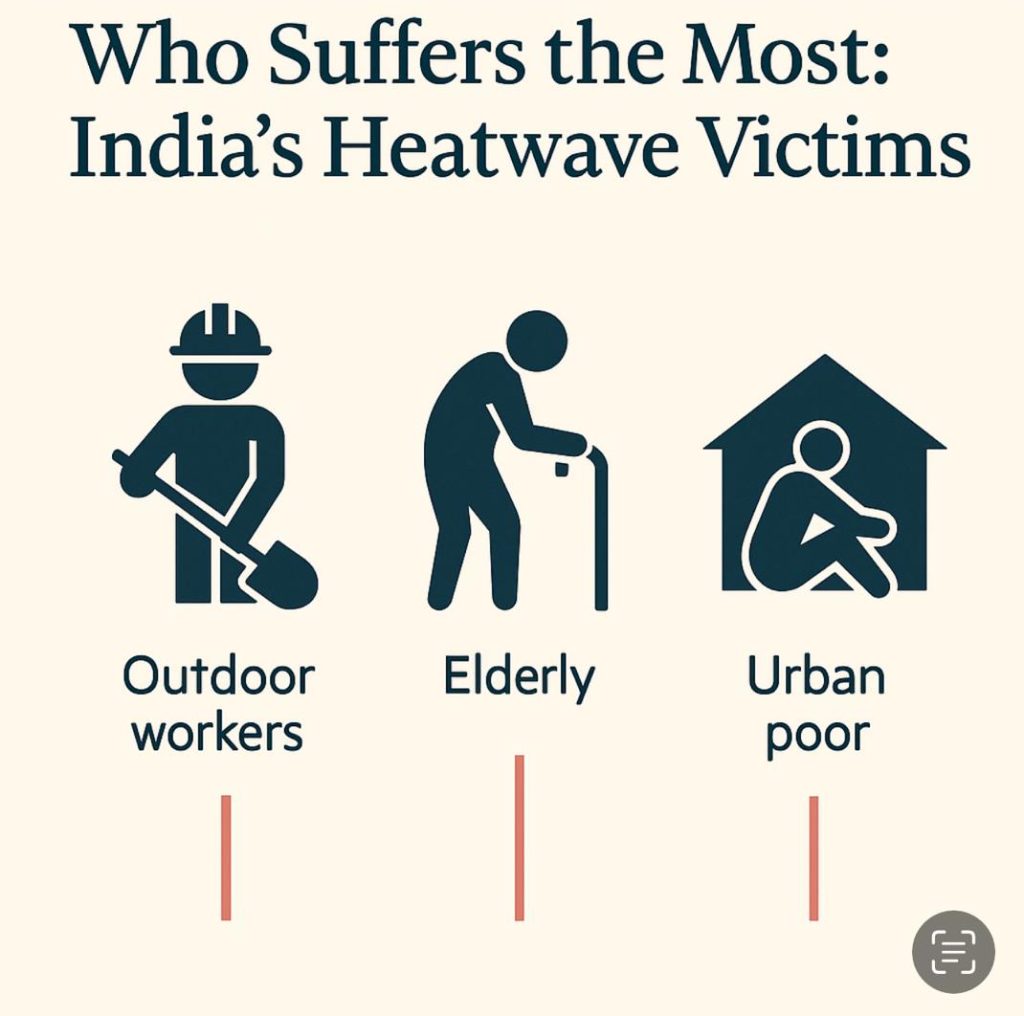
Those who labour outdoors—construction workers, farmers, street vendors, sanitation staff—bear the heaviest heat load. They also have the least access to healthcare, drinking water, or shaded shelter. According to recent analysis, a single day of intense heat in India causes roughly 3,400 excess deaths. A five-day heatwave can claim over 30,000 lives, mostly among the poor and elderly.
States like Uttar Pradesh, Bihar, Rajasthan, and Odisha are particularly at risk. In cities such as Prayagraj, Patna, Kanpur, and Lucknow, each major heatwave sees over 180 more deaths. Uttar Pradesh alone may account for 8,000 fatalities during a typical summer heatwave cycle.
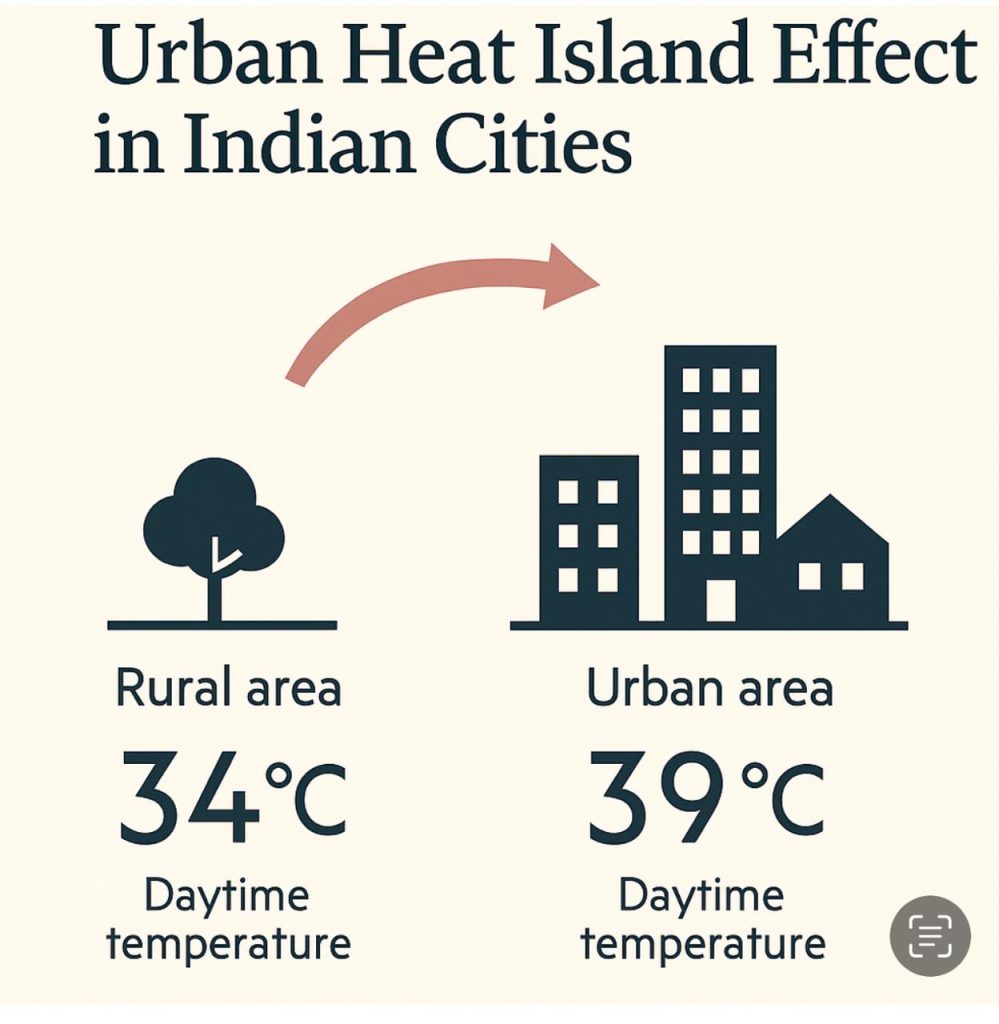
India’s cities—supposed engines of growth—are fast becoming uninhabitable during peak summer. The phenomenon of urban heat islands means that densely built-up areas, laden with concrete and asphalt, absorb and keep heat, making nights hotter than days.
Delhi, Ahmedabad, Chennai, and Nagpur regularly record nighttime temperatures above 32°C, leaving little room for physiological recovery. Air conditioning remains a luxury for most. Frequent power outages in smaller towns make cooling unreliable even where available.
Moreover, India’s municipal building codes and city masterplans have not caught up with climate reality. Reflective roofs, shaded pavements, green corridors, and water-sensitive design are still exceptions. Instead, haphazard real estate development is intensifying heat stress.
Rural India is no safer. In fact, it is more vulnerable in many ways. Farmers are increasingly reporting heat-stressed crops, especially wheat and pulses, which are highly sensitive to temperature fluctuations. Heatwaves shorten the Rabi season and reduce yields. The livestock sector is also reporting abnormal mortality due to heat exhaustion and dehydration.
Water scarcity worsens the crisis. With groundwater depletion accelerating and monsoon patterns becoming erratic, entire regions—from Marathwada to Bundelkhand—face the dual burden of drought and extreme heat. These areas are becoming unliveable, pushing more people to migrate to already overstressed urban centres.
In theory, India has recognised the problem. The India Cooling Action Plan (ICAP) aims to reduce cooling demand by 25% and cut refrigerant usage by 30% by 2037. The Long-Term Low Emission Development Strategy (LT-LEDS) commits India to net-zero by 2070 and includes several climate adaptation components.
But on the ground, the story is different. Only about 30 Indian cities have developed Heat Action Plans (HAPs)—and fewer still have implemented them effectively. The plans often lack funding, trained personnel, and real-time response systems. Cooling centres remain rare. Community outreach is limited to pamphlets. Public health systems are stretched even in normal conditions.
Europe’s struggle with heat is forcing policy shifts—from cooling subsidies to green infrastructure investments. But for India, the stakes are existential. Climate change is not just a policy issue—it’s a survival issue for millions.
Yet adaptation finance—both global and domestic—is woefully inadequate. While billions have flowed into solar and EV sectors, less than 20% of India’s climate-related funds are directed at adaptation. Even fewer reach the local communities most affected by heat.
What India needs is not just more weather warnings. It needs a radical rethinking of how cities, villages, and workspaces are designed and managed.
India cannot afford to be reactive. The time for piecemeal interventions is over. What’s needed is a whole-of-government, whole-of-society approach to make the country heat-resilient.
For if Europe is the present, India could be the future—unless we act now.