Executive Summary
This update examines India’s accelerating energy transition through multiple lenses: record renewable growth driving historic emissions reductions, transformative GST reforms unleashing investment, and ambitious infrastructure modernisation plans. We explore corporate developments at Tata Power and Adani Power, regional initiatives in Haryana’s decentralised energy programme, improved mine worker safety protocols, and international partnerships including Zimbabwe’s Jindal deal. The analysis reveals a sector reaching an inflection point where policy, investment and technology converge to reshape India’s energy landscape fundamentally.
Energy Prices Hold Firm but Global Volatility Looms
India’s energy markets are calm but cautious as WTI crude sits at $63.75 per barrel and Brent at approximately $68.27—both metrics sitting below last year’s levels yet showing resilience. Natural gas prices globally are near $3.10 per MMBtu, and in India, MCX futures trade at ₹273.40. Electricity tariffs for residential users remain accessible, ranging ₹3–₹8 per kWh, while commercial rates sit at ₹8–₹13 depending on urban consumption. Solar is now the nation’s price leader at ₹2.50/kWh, outpacing fossil alternatives following recent GST reforms. The landscape signals stable supply and policy restraint, with little sign of disruptive volatility or sudden price shocks. As international benchmarks shift and India speeds toward a more sustainable mix, energy planners are keeping a close eye on affordability and demand while strengthening domestic production. The tone across markets is neutral to positive marked by modest optimism and stable undercurrents.

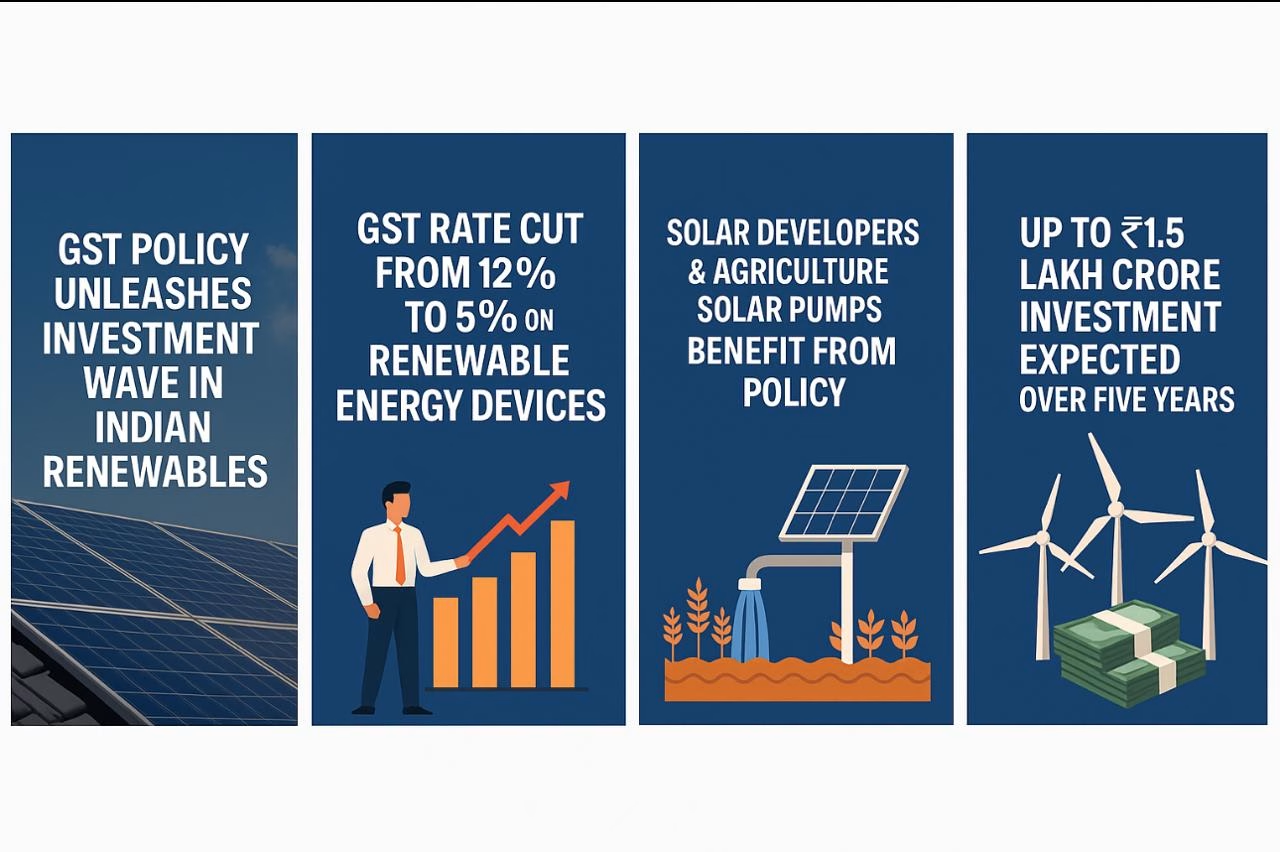
GST Policy Unleashes Investment Wave in Indian Renewables
A landmark GST rate cut on renewable energy devices, slashed from 12% to 5%, effective September 22, 2025, is transforming the investment climate across India’s clean energy sector. The move enables solar developers to lower project costs by nearly ₹25 lakh per megawatt, with rooftop systems now up to ₹10,500 cheaper for households. The policy is making agricultural solar pumps more affordable, knocking ₹17,500 off each unit and directly benefiting India’s vast farming community. Industry experts expect the catalyst will unlock up to ₹1.5 lakh crore in new investments over five years, accelerate solar and wind adoption, and save consumers around ₹3,000 crore annually in procurement. The impact is immediate and widespread—developers are reporting increased financing, faster commissioning, and broader job creation. At a time when global energy economics are shifting, GST reform stands out as a highly positive spark for Indian climate and growth ambitions.
Clean Energy Drives Historic Drop in India’s CO₂ Emissions
India’s power sector has registered a 1% decline in carbon dioxide emissions during the first half of 2025, breaking a fifty-year pattern with only one similar dip on record. This progress reflects the rapid deployment of renewables, increased hydropower generation boosted by unusually cool and wet weather, and a slight moderation in electricity demand. Renewables capacity expanded by 25 GW—a 69% leap over past peaks—while fossil power generation slipped by 29 terawatt-hours. Experts attribute 65% of the emission drop to lowered demand, 20% to clean energy growth, and 15% to hydro gains. The achievement puts India’s climate goals, including 500 GW of non-fossil capacity by 2030, on stronger footing and signals a shifting dynamic in energy production. With infrastructure programmes in place and grid modernisation underway, momentum is building for further decarbonisation. Tone is positive: a pivotal step in the nation’s clean power story.
India Bets Big on Geothermal in Clean Energy Expansion
Marking a major leap in renewables strategy, India has launched its first national geothermal energy policy, aiming to tap up to 10 GW of earth-based potential over the coming decade. The initiative is rooted in global partnerships, with Norway, Iceland, and the US offering technical and research support for pilot projects. Plans include converting abandoned oil fields, integrating geothermal with solar-hybrids, and building skilled teams for advanced deployment. While capital costs are high for initial phases, the government’s focus on fiscal support and phased scaling is expected to drive competitiveness as expertise grows. By broadening the nation’s energy mix, this policy is designed not only to diversify infrastructure but also reinforce grid reliability and long-term sustainability. Sector analysts see the move as prudent and innovative—a positive step toward leveraging India’s unique geology for resilience and climate progress.
Grid Overhaul Powers India’s Renewable Ambitions
India’s National Electricity Plan has set in motion a ₹9.15 lakh crore investment for a dramatic transmission network upgrade, growing capacity from 4.85 lakh to 6.48 lakh circuit kilometres by 2032. This initiative will enable absorption of 280 GW in new renewables, support green hydrogen clusters, and lift rural electrification. Already, 42 GW of transmission lines are complete, 85 GW under active construction, and a further 75 GW in open bidding—creating a robust platform for the grid’s future. The overhaul is timed to meet a forecast peak demand of 458 GW, with pumped storage and advanced management tools in tow. As solar and wind overtake coal in installed capacity, analysts anticipate greater reliability and market confidence. The tone is strongly positive: this is infrastructure driving global leadership in clean energy integration, supply security, and equitable growth.
Foreign Capital Floods into a Diversifying Energy Sector
India’s transformation in energy investment is increasingly driven by foreign direct inflows, with a sector-wide tally now above $19.68bn and renewables claiming $21.33bn in the past fiscal year. Major capacity milestones include 466 GW—split across coal (220 GW), solar (100 GW), wind (48 GW), and hydro (47 GW). Recent reforms enabling 100% foreign participation have accelerated project financing and technology transfer, while private-public partnerships lead innovation and rural outreach. The sector blueprint targets 609 GW installed, with 500 GW set for non-fossil fuels by 2030. While grid and storage challenges persist, India’s diverse and rapidly scaling energy portfolio is drawing global investor confidence, supporting new jobs, cleaner growth, and greater resilience. Editorial tone is positive, underlining investor momentum and sectoral maturation.
Safety Net Rises for India’s Mine Workers
Coal India and Hindustan Copper have rolled out sweeping improvements in mine safety compensation, boosting fatality ex gratia to ₹25 lakh and providing enhanced accident coverage—₹1 crore for regular employees and ₹40 lakh for contract staff. The new “We Care” programme speeds payment processing and establishes uniform social protection protocols, addressing the historic vulnerabilities faced by workers in high-risk environments. Employee groups have welcomed tangible gains in welfare despite calls for ongoing investment in safety culture and hazard prevention. The reforms align with broader efforts to elevate standards and promote dignified labour in extractive industries. Editorial tone is cautiously positive—gains are clear, but systemic change must continue if mines are to become truly safe workplaces.
NTPC Green Energy Scales Up With Bhuj Solar Launch
NTPC Green Energy has brought its 25 MW solar plant in Bhuj, Gujarat into commercial operation, expanding its installed renewables portfolio beyond 7,200 MW and deepening collaboration within the ONGC NTPC Green platform. The project is a bellwether for India’s ambitious 500 GW non-fossil target, blending public and private strengths for faster scale and technical sophistication. Ayana Renewables and other private partners have helped ensure efficient deployment and integration. While solar remains the headline driver, NTPC’s expansion now includes hybrid configurations and greater grid flexibility. Sector analysts view NGEL’s progress as foundational, pointing to replicable models for state-led clean energy growth. The overall tone is positive, highlighting reliable project execution and sectoral leadership.
Tata Power Sustains Profitable Growth, Eyes Nuclear Future
Tata Power has maintained profitability for 23 consecutive quarters, growing generation capacity from 18.15 GW to 30.67 GW through both brownfield expansions and planning for future nuclear ventures. Pending regulatory approvals, the company is poised to diversify into small modular nuclear reactors (SMRs). These strategic movements enhance resilience amid ebbs and flows in renewables market demand and sector-wide infrastructure delays. Tata Power’s balance sheet, execution rate, and innovation roadmap remain strong—earning analyst confidence. Long-term growth will depend on regulatory clarity and continued technological leadership in both renewables and nuclear. The editorial tone is positive, marking Tata Power’s ability to deliver results while adapting to evolving energy realities.
Adani Power Drives Transition With Low-Emission Coal and Retail Momentum
Adani Power is staking out the next phase of its expansion with plans for an additional 12.1 GW in capacity and a focus on advanced, low-emission coal technologies. The company’s recent 1:5 stock split attracted stronger retail investor engagement, broadening its market footprint. Industry awards for ESG innovation reinforce Adani’s commitment to cleaner operations. While regulatory volatility and sectoral coal dependency remain watchpoints, strong fundamentals and technical upgrades underpin short- to mid-term optimism. As the competitive landscape adjusts for faster renewable scaling, Adani Power’s agility and tech investment set the stage for resilient growth. Tone is cautiously positive—progress in sustainability is real, but the journey ahead demands vigilance.
Haryana Advances Rural Access with Decentralised Renewables
The Haryana government is pioneering last-mile clean energy access through a new programme that deploys decentralised solar panels, biogas facilities, and battery storage in underserved villages. The initiative—funded via central, state, and private collaboration—has reduced grid congestion and enabled reliable power for rural homes and productive farms. Initial results are promising, but scalability and real-world resilience will be vital as models expand across other regions. Community feedback indicates strong support for localised solutions, marking a shift from megaprojects to grassroots innovation. The tone is positive, with particular emphasis on replicability, empowerment, and alignment with climate resilience and development goals.
Zimbabwe-Jindal Pact Revamps African Power Infrastructure
Zimbabwe has inked a $455m agreement with Jindal’s Africa division to modernise the ageing Hwange power plant—a deal set to add engineering muscle and financial resources to southern Africa’s infrastructure portfolio. The high-profile partnership aims for increased reliability and supply to regional grids, with both parties emphasising the benefits for trade and bilateral ties. Past challenges in energy project execution still hover, leaving ongoing risk management central to long-term outcomes. Yet, the willingness to invest and cooperate at scale provides cautious optimism for sustainable infrastructure growth. Overall tone reflects the calculated enthusiasm and realism that shapes cross-border energy deals.
Renewables Break Records As Coal Output Slides in India
India’s renewables sector has surged past expectations with a 24.4% rise in output during the first half of 2025—the fastest growth since 2022. Solar capacity remains the central engine while wind and hydropower fill supporting roles. Meanwhile, coal generation has continued its downward trajectory, opening the door for cleaner sources to cover all incremental demand in the years ahead. Grid modernisation efforts and policy reforms are accelerating the move toward 100% non-fossil additions by 2030. Analysts say this marks a historic inflection point, as both public and private deployment strategies converge on scale and speed. Editorial tone is strongly positive, projecting a future in which renewables dominate Indian generation and global clean energy transitions.