Thursday, April 16

Author: Pallab Bhattacharya

India’s Solar Revolution Finds Its Missing Spark in Female Talent
Newsletter, Renewables

India’s Solar Revolution Finds Its Missing Spark in Female Talent

Executive note: Finds Its Missing Spark in Female Talent India’s renewable sector employs 1.02 million with 3.4 million jobs projected by 2030 Women hold 43% of STEM degrees but just 11% of clean energy positions• Projects with female participation show superior completion rates and stakeholder engagement Gender-diverse teams deliver measurably better outcomes in complex energy infrastructure Untapped talent pool could accelerate India’s 500GW renewable   The change is discernible, but, is the pace of change quite remarkable? World’s most populous country has embarked on a ‘Great Green Revolution’, but if the 50 per cent of its population-the women- is truly getting what it deserves? Whether renewables, that bring a new hope to surmount energy deficiency, pav...
The Energy Wars: How Oil is Redrawing the World Map
Geopolitics, Newsletter, Opinion

The Energy Wars: How Oil is Redrawing the World Map

Executive Summary Since Russia’s 2022 Ukraine invasion, global oil trade has undergone its most dramatic transformation in decades. India emerged as an unlikely beneficiary, increasing Russian crude imports from negligible volumes to 1.6 million barrels daily—40% of total imports—generating $2.7 billion monthly savings through $15-20 per barrel discounts. Western sanctions triggered a 60% redirection of Russian exports from Europe to Asia within 18 months, enabling Moscow to earn $119 billion from oil sales in 2024. The crisis accelerated alternative payment systems bypassing Western financial infrastructure, while creating permanent market fragmentation along geopolitical lines that may outlast the conflict itself.   Trade, Tariff, Trump and  Tremor In the three years since Russi...
Why Energy Journalism Matters More Than Ever
Opinion

Why Energy Journalism Matters More Than Ever

Four decades of covering energy markets teaches you one thing: complexity never simplifies, it just shifts. I began as a journalist in Kolkata when energy meant keeping lights on. Two decades later, I joined ONGC for another twenty years—learning how boardroom strategies translate into operational reality. Training across India and Europe on energy transition revealed a truth: everyone’s improvising, some just do it more elegantly. Today’s energy paradoxes fascinate me. Shell invests billions in renewables while expanding oil operations. Governments promise net-zero while securing gas imports. Solar costs collapse, yet grid infrastructure requires trillions. This isn’t contradiction—it’s transformation at civilizational scale. Newscript Energy World was conceived for this momen...
The ESG Divide: India’s Corporate Leaders and Laggards
ESG

The ESG Divide: India’s Corporate Leaders and Laggards

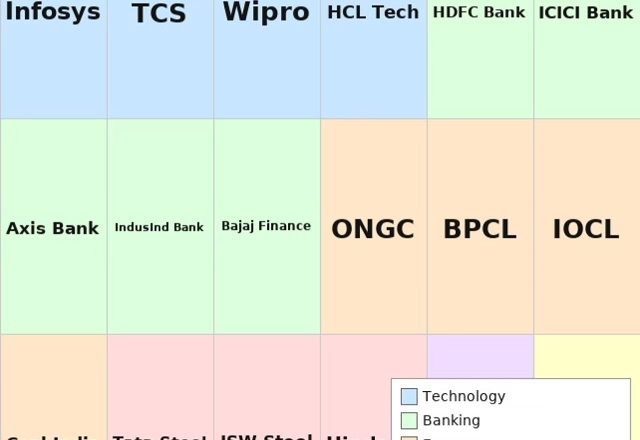
India’s technology and banking giants are setting global benchmarks in ESG performance, while state-owned energy firms and heavy industries struggle to meet net zero targets. The widening gap is reshaping capital access, competitiveness and the future of corporate sustainability in India. Technology drives India’s ESG leadership Infosys has achieved carbon neutrality in India for six consecutive years under PAS 2060 standards, with 39.6 per cent of its workforce women and nearly 30m sq ft of green-certified office space. Tata Consultancy Services has reduced emissions by 80 per cent since 2016, sourced 74 per cent of its electricity from renewables in FY24, and aims for net zero by 2030. Wipro and HCL Technologies also publish detailed BRSR disclosures, aligning with SEBI’s ESG report...
India’s ESG awakening: where reality meets rhetoric
ESG

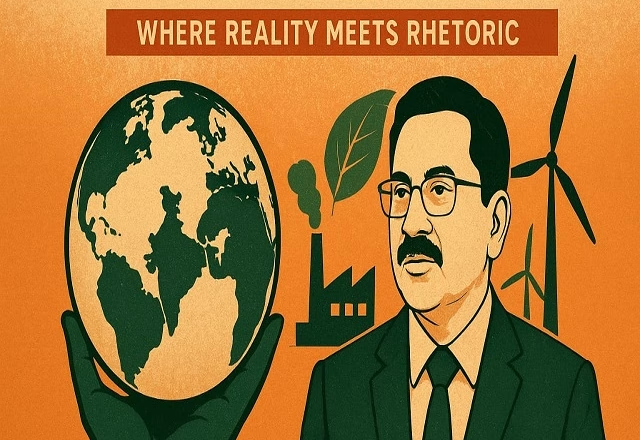
India’s ESG awakening: where reality meets rhetoric

Walk into any Indian boardroom today and ESG is likely to come up within the first ten minutes. What started as a grudging nod to international investors has become something more urgent: a factor that determines whether companies can export to Europe, attract capital, or even retain customers. The numbers reflect this shift. Consumer surveys consistently show that environmental performance influences purchasing decisions, while asset managers screen investments through ESG criteria. For Indian businesses, this represents both an opening and a challenge they can’t sidestep. Winners and strugglers Some companies have embraced the change. Adani Green Energy now scores 74 out of 100 on NSE’s sustainability ratings—the highest in India’s power sector. The company’s rapid expansion in rene...
India’s Energy Crossroads: Adani’s ₹10,500 Crore Investment Marks Coal’s Enduring Role
Power

India’s Energy Crossroads: Adani’s ₹10,500 Crore Investment Marks Coal’s Enduring Role

India’s clean energy ambitions face a pragmatic reckoning as Adani Power commits ₹10,500 crore to an 800 MW ultra-supercritical coal-fired power plant in Madhya Pradesh. The decision spots coal firmly at the heart of India’s energy security through the early 2030s despite lofty renewable targets. Scheduled for commissioning within 54 months, the plant will be built under a Design, Build, Finance, Own and Operate model in Anuppur district, sourcing coal under the government’s SHAKTI policy to ensure fuel availability. The tariff was competitively secured at ₹5.838 per kilowatt-hour. This investment aligns with government plans to add 88 GW of coal capacity by 2032—a 63% increase from earlier projections—placing India alongside China as one of the few countries still expanding thermal ...
India’s Ethanol Gamble Tests Energy Policy and Consumer Patience
ESG, Oil & Gas Industry

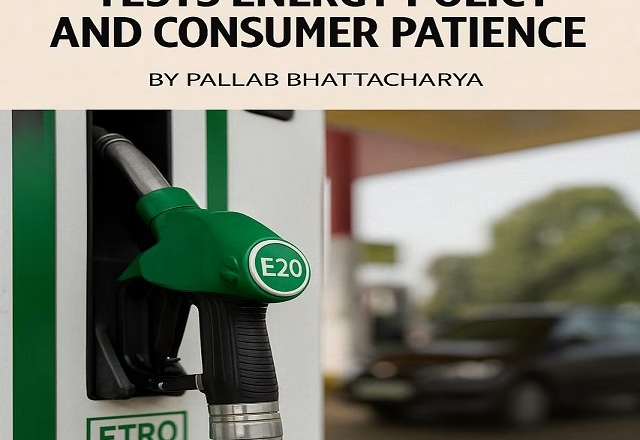
India’s Ethanol Gamble Tests Energy Policy and Consumer Patience

India’s nationwide rollout of E20 petrol—fuel blended with 20% ethanol—marks one of the most ambitious interventions in the country’s energy and agriculture strategy. Officials forecast annual foreign exchange savings of ₹43,000 crore, a cumulative ₹1.44 lakh crore since 2014, and direct payments of ₹40,000 crore to sugarcane farmers this year. Yet consumers and automakers are already confronting the practical costs of transition, while environmental and agricultural trade-offs sharpen the policy debate. Energy and farm economics The government says E20 has displaced 245 lakh metric tonnes of crude oil, cutting import costs and stabilising rural incomes. For sugarcane growers, surplus harvests now feed distilleries, easing payment delays and supporting local job creation. Policymakers fr...
Gas and aviation fuel tax reform tests GST Council’s resolve
Oil & Gas Industry

Gas and aviation fuel tax reform tests GST Council’s resolve

Fiscal pressures and rising energy import dependence add urgency to long-standing reform debate. India’s GST Council convenes next week facing pressure to bring natural gas and aviation turbine fuel under its tax net — a decision that could reshape two critical sectors and offer relief from mounting fiscal pressures. The September 3-4 meeting will examine whether to end the anomalous treatment of both fuels, which remain outside the goods and services tax framework. Currently subject to a patchwork of state VAT and central excise duties, the arrangement has created what industry executives describe as a compliance nightmare. The timing couldn’t be more awkward. India’s energy import bill has climbed above $170bn annually with little sign of abating. With crude oil imports accounti...
Gas Gamble in India’s Remote Northeast
Oil & Gas Industry

Gas Gamble in India’s Remote Northeast

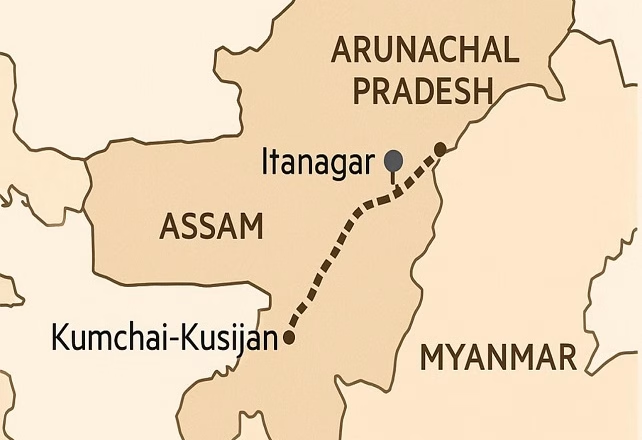
Oil India Limited (OIL) and Bharat Petroleum Corporation Limited (BPCL) have agreed to set up Arunachal Pradesh’s first state-wide City Gas Distribution (CGD) network, taking India’s natural gas expansion to one of its most sparsely populated and geographically difficult states. The licence, awarded under the 12th round of the Petroleum and Natural Gas Regulatory Board (PNGRB), covers the entire state rather than select districts, making it the first comprehensive CGD concession in India’s northeastern frontier. Structure and Infrastructure The venture will be operted as a 50:50 joint venture between the two state-run energy companies, with provision for the Arunachal Pradesh government to take up to 10 per cent equity. The network will include compressed natural gas (CNG) stations fo...
Social Media Auto Publish Powered By : XYZScripts.com