
Executive note:
Finds Its Missing Spark in Female Talent
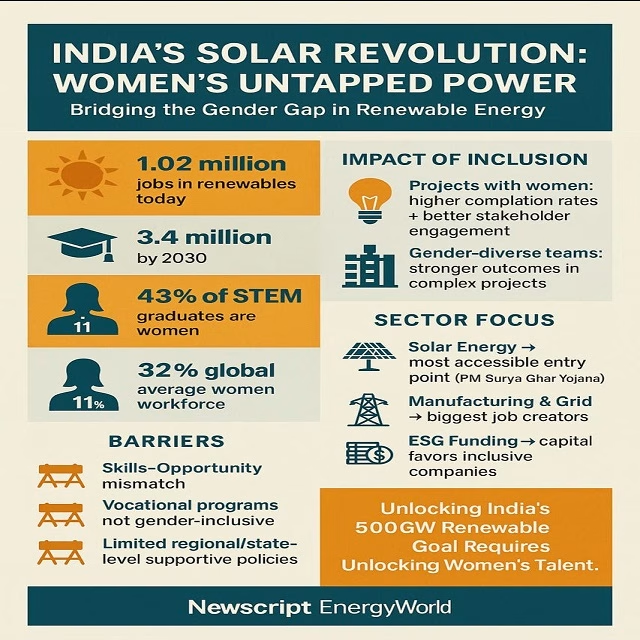
- India’s renewable sector employs 1.02 million with 3.4 million jobs projected by 2030
- Women hold 43% of STEM degrees but just 11% of clean energy positions• Projects with female participation show superior completion rates and stakeholder engagement
- Gender-diverse teams deliver measurably better outcomes in complex energy infrastructure
- Untapped talent pool could accelerate India’s 500GW renewable
The change is discernible, but, is the pace of change quite remarkable? World’s most populous country has embarked on a ‘Great Green Revolution’, but if the 50 per cent of its population-the women- is truly getting what it deserves? Whether renewables, that bring a new hope to surmount energy deficiency, pave the way for 43 per cent STEM-qualified women at par with their male counterparts? All these questions and many more inspire us to examine the situation and bring out the truth that shapes our new EnergyWorld. Lets take a look at the challenges and opportunities, transformations and taboos, Promise or Procrastination.
India’s renewable energy sector has reached a milestone of 1.02 million jobs, according to the Ministry of New and Renewable Energy, with government projections indicating growth to 3.4 million positions by 2030. Yet the sector faces a puzzling contradiction: while women earn 43 percent of India’s STEM degrees, they occupy just 11 percent of renewable energy positions.
The numbers tell a story of untapped potential. India needs to achieve 500GW of renewable capacity by 2030, requiring massive workforce expansion from current levels. With renewable energy jobs already growing at 18.9 percent annually, the question isn’t whether opportunities exist—it’s whether India can afford to ignore half its qualified talent pool.
The employment landscape
Current renewable capacity stands at 235.7GW as of June 2025, with solar contributing significantly to this figure. The sector’s rapid expansion has created employment across manufacturing, installation, maintenance, and grid integration roles. However, participation patterns reveal significant gender gaps that mirror broader STEM employment trends.
Women represent 32 percent of the global renewable workforce, nearly triple India’s participation rate. This international comparison suggests systemic barriers rather than capability constraints affect Indian women’s energy sector employment
Skills and opportunity mismatch
The disconnect between education and employment becomes stark when examining specific qualifications. Engineering graduates with specializations in electrical, mechanical, and environmental disciplines—areas directly relevant to renewable energy—show substantial gender representation in academic programs but dramatic drop-offs in industry hiring.
Solar energy offers the most accessible entry point, with distributed installations creating local employment opportunities. Rooftop solar programs under the PM Surya Ghar Yojana specifically target household decision-makers, acknowledging women’s influence in technology adoption.
Economic implications
McKinsey Global Institute research suggests women’s increased workforce participation could add $700 billion to India’s GDP by 2025. The renewable sector represents concentrated opportunity for realizing these economic gains through targeted inclusion.
Corporate finance considerations now amplify inclusion incentives. ESG investment criteria increasingly influence energy sector funding, with gender diversity metrics affecting capital access and borrowing costs. Companies demonstrating inclusive practices gain preferential treatment from institutional investors focused on sustainable development goals.
Training and development gaps
Current vocational education approaches fail to address barriers preventing qualified women from accessing renewable energy careers. Technical training programs in solar installation, wind turbine maintenance, and grid integration require deliberate redesign to attract female participants.
The CEEW report on India’s expanding clean energy workforce identifies skills development as a critical bottleneck for meeting 2030 targets. Addressing gender participation could significantly accelerate progress toward these goals.
Sector-specific opportunities
Manufacturing represents the largest employment category within renewables, with assembly operations suited to diverse skill sets. Quality control, process optimization, and supply chain coordination roles align well with engineering competencies regardless of gender.
Grid integration and energy storage technologies present emerging opportunities requiring analytical capabilities. Smart grid development and battery management systems demand technical skills that vocational programs could develop through focused training initiatives.
Regional variations
State-level policies show significant impact on women’s renewable energy participation. Programs with supportive frameworks achieve higher female workforce integration, suggesting scalable approaches for national application.
Distributed energy projects perform particularly well in this regard. Small-scale installations avoid geographic constraints typical of large utility projects while creating local employment suited to community-based approaches.
Corporate diversification trends
Traditional energy companies pursuing renewable investments recognize gender inclusion’s strategic value. Oil and gas firms can leverage diversity to differentiate their clean energy ventures while providing career transition pathways for experienced professionals.
This cross-sector movement accelerates renewable deployment while maximizing existing technical expertise across energy industries.
Future workforce requirements
The transition from 1.02 million current jobs to 3.4 million by 2030 requires systematic workforce planning. Meeting these targets while maintaining technical standards demands optimal talent deployment across all demographic segments.
Research and development activities increasingly require diverse analytical perspectives. Government laboratories and private facilities developing indigenous technologies benefit from varied approaches to complex technical challenges.
Policy framework evolution
Government initiatives now recognize gender inclusion as essential for meeting renewable targets rather than optional social policy. The PM Surya Ghar Yojana’s focus on household decision-making acknowledges empirical evidence about women’s technology adoption influence.
Technical education policies require updating to address systematic barriers in renewable energy career pathways. Current approaches produce qualified graduates but fail to connect them with appropriate industry opportunities.
Investment and growth patterns
The renewable sector’s 18.9 percent annual hiring growth creates natural momentum for inclusive employment practices. Companies recognizing this demographic opportunity position themselves advantageously for continued expansion.
Solar capacity growth from current levels toward targeted 300GW contribution requires workforce development across installation, maintenance, and grid integration functions. These roles offer technical career paths suitable for diverse recruitment strategies.
Meeting India’s 500GW renewable target depends on maximizing workforce capabilities across all available talent pools. With women representing 43 percent of STEM graduates but only 11 percent of renewable employment, systematic inclusion could accelerate both project development and economic growth objectives.
The sector’s continued expansion creates unprecedented opportunity for addressing historical workforce gaps while meeting critical infrastructure development goals. Success requires deliberate policy intervention and corporate commitment to inclusive hiring practices that recognise talent regardless of demographic characteristics.
Pallab Bhattacharya is the former Executive Director – Chief of Corporate Communications at ONGC.
A senior journalist. Now, he is the founder and Editor-in-Chief of Newscript