
Tehran’s IAEA suspension jolts oil markets, heightens geopolitical risk, and forces import-dependent nations like India to reframe energy strategies
The ripples were quite visible among the global diplomatic and political circles when Iranian President Masoud Pezeshkian signed a legislative decree on July 2, barring International Atomic Energy Agency (IAEA) inspectors from accessing the country’s nuclear facilities,
Within hours, oil prices surged over 3%, and nervous chatter filled diplomatic corridors from Brussels to Beijing. But nowhere was the tremor more acutely felt than in the global energy markets—already grappling with post-pandemic demand volatility, supply chain fragilities, and climate transition dilemmas.
Iran’s move, described by Germany’s foreign ministry as a “point of no return” in nuclear diplomacy, could well be the most consequential geopolitical event for the energy sector since Russia’s 2022 invasion of Ukraine. In suspending IAEA cooperation, Tehran has effectively removed the last layer of transparency from a nuclear programme long suspected of being weaponised behind closed doors.
Strategic Defiance, Tactical Fallout
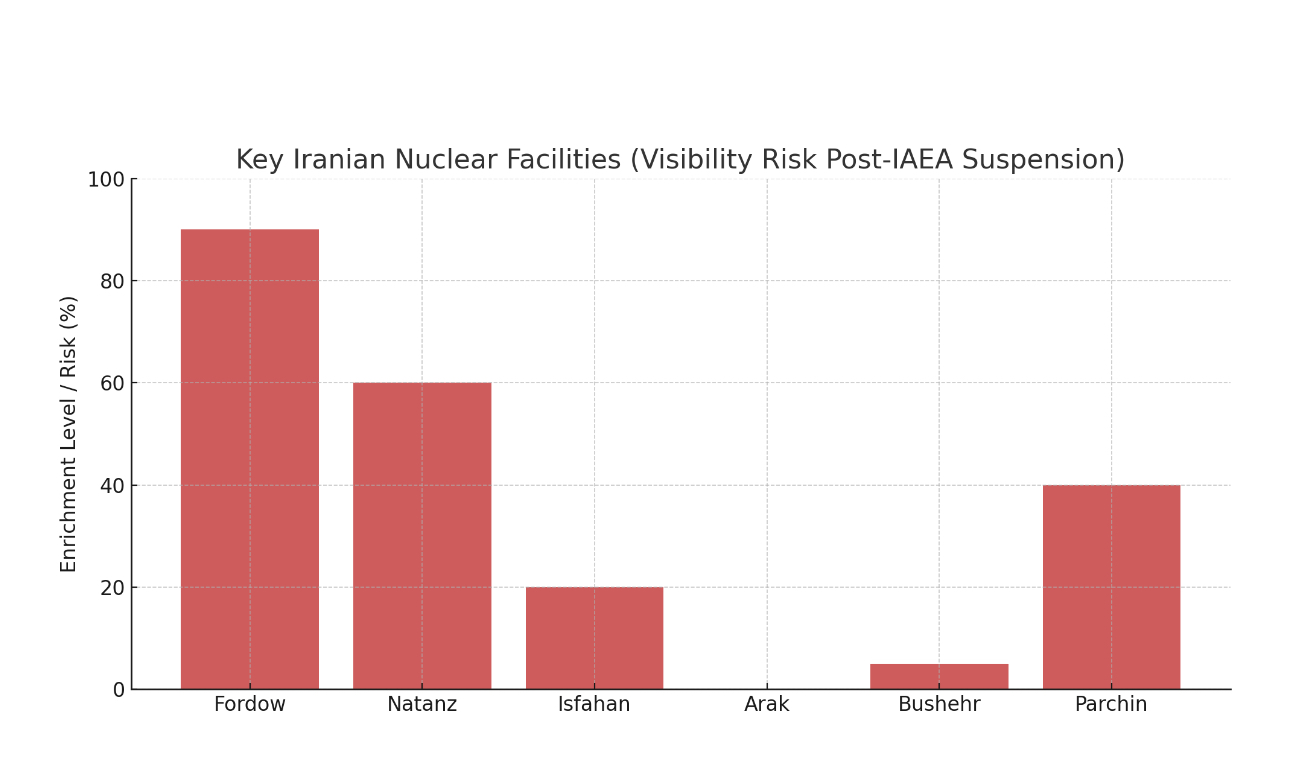
The legislation, passed in Iran’s Majlis with 221 votes in favour and just one abstention, is widely viewed as a retaliatory measure following coordinated Israeli and US strikes in June on Iran’s nuclear installations at Fordow, Natanz, and Isfahan. These attacks—denounced by Tehran as “acts of war”—crippled centrifuge operations and reportedly injured nuclear scientists. Yet the IAEA, under Director General Rafael Grossi, declined to assign blame, instead reiterating concerns over Iran’s “increasing lack of transparency.”
“The Islamic Republic will not allow the tools of diplomacy to become instruments of surveillance,” said Iranian foreign minister Ali Bagheri Kani during a fiery press conference in Tehran. “The era of one-sided inspections is over.”
While the international community debates the legality of Iran’s decision, energy markets have already priced in a fresh round of uncertainty. Brent crude jumped to $68.01 per barrel and WTI hovered near $66.27—a reflexive reaction to what Giovanni Staunovo, energy strategist at UBS, called a “geopolitical fear premium.”
Chokepoints and Vulnerabilities
At the heart of global anxiety lies the Strait of Hormuz, a narrow maritime corridor through which more than 20% of the world’s seaborne oil flows. Iran has repeatedly threatened to “close the tap” if provoked militarily—an eventuality that could spark a catastrophic spike in energy prices, disrupt trade routes, and intensify inflationary pressures in energy-importing countries.
Iran’s daily oil exports, which range between 1.5 and 2 million barrels per day despite sanctions, are largely absorbed by China. But their strategic value lies not in volume but in volatility. “Iran’s exports are the wildcard in OPEC+’s already delicate balancing act,” said Amrita Sen, co-founder of Energy Aspects, a UK-based consultancy. “The moment you remove IAEA oversight, you invite secondary sanctions, tanker seizures, and speculative hoarding.”
OPEC+, which plans to increase production by 411,000 barrels per day in August, is watching the developments closely. Though the cartel has not issued an official statement, several Gulf delegates expressed concern in closed-door meetings, according to Reuters reports.
India: Caught in the Crossfire
For India, the world’s third-largest oil importer, the implications are especially severe. Over 85% of its crude is imported, much of it routed through the very chokepoints now under threat. With consumption rising above 5 million barrels per day in 2025, any disruption in Middle Eastern supplies poses a direct threat to economic stability, currency reserves, and inflation management.
“India cannot afford to remain a passive observer,” said Ajay Srivastava, co-founder of the Global Trade Research Initiative. “The strategic calculus has changed. We need to prepare for energy weaponisation.”
Indeed, India has begun to recalibrate. The Petroleum Ministry has greenlit the expansion of its Strategic Petroleum Reserve (SPR) by over 12 million tonnes. Six new underground storage facilities—four rock caverns and two salt domes—are being planned, with detailed project reports underway by Engineers India Ltd. Among the shortlisted sites are Mangalore SEZ, Chandikhol in Odisha, and Bikaner in Rajasthan, tapping both geographic spread and geological advantage.
These new facilities will augment the current SPR capacity of 5.33 million tonnes spread across Mangalore, Padur, and Vizag. The government aims to meet the International Energy Agency’s requirement of 90 days of strategic reserves—up from the current 75-day buffer, which includes stocks held by Indian refiners.
“This isn’t just a policy shift. It’s an existential adjustment to an increasingly fragmented energy world,” said Shambhu S. Kumaran, India’s Permanent Representative to the IAEA, who voiced “deep concern” at the agency’s emergency board meeting in Vienna.
Europe and the ‘Snapback’ Threat
The diplomatic reverberations have been no less intense. France’s President Emmanuel Macron, after a call with Russia’s Vladimir Putin, warned that Europe may consider activating the “snapback” clause in the 2015 Joint Comprehensive Plan of Action (JCPOA), which would automatically reinstate all UN sanctions against Iran. Israeli foreign minister Gideon Saar, in a statement to Knesset, urged immediate action, calling Iran’s decision “a brazen act of nuclear blackmail.”
In Washington, US State Department spokesperson Tammy Bruce termed Tehran’s move “reckless and unacceptable,” warning that time was running out to restore a diplomatic pathway. Though both American and Israeli intelligence agencies remain tight-lipped on the status of Iran’s enrichment capacity post-strikes, satellite imagery and independent analysts suggest that some facilities may already be rebuilt with Chinese technical assistance.
Of greatest concern is the stockpile of enriched uranium. As per leaked data from the IAEA’s last inspection, Iran possessed nearly 400 kilograms of uranium enriched to 60% purity—enough, according to proliferation experts, to assemble at least 10 nuclear warheads within a short breakout period.
A World on Edge
For energy markets, the key question now is whether Iran’s nuclear gambit will escalate into regional confrontation—or settle into a tense diplomatic stalemate. “Markets hate uncertainty more than they fear conflict,” said Helima Croft, head of global commodity strategy at RBC Capital Markets. “As long as IAEA remains shut out, traders will price in worst-case scenarios.”
India, alongside other major importers such as Japan and South Korea, is also re-evaluating long-term contracts and diversifying supply chains. Greater reliance on the US, Brazil, and West African exporters is on the table, but geopolitical complexities and freight costs remain obstacles.
Meanwhile, private refiners like Reliance Industries and Nayara Energy have begun quietly adjusting sourcing matrices, according to industry sources. “Nobody wants to be caught off guard again,” one executive remarked under condition of anonymity. “Energy security is now national security.”
The Next 90 Days
The next three months will be crucial. If IAEA inspectors remain barred, and Iran continues enrichment activities unchecked, the international community will likely respond with economic measures, possibly coordinated naval patrols in the Gulf, and attempts to resurrect multilateral pressure mechanisms.
For India, that timeline overlaps with peak monsoon season—a period when energy logistics face additional strain. A full-scale oil price shock could push fiscal deficit projections off course and threaten the Reserve Bank of India’s inflation targeting framework.
As one energy diplomat put it: “We are entering a phase where the playbook of the past no longer applies. Energy diplomacy must now be as agile as energy transition.”
Meta Keywords: Iran nuclear crisis, IAEA suspension, oil prices, Brent crude, India strategic reserves, Strait of Hormuz, energy diplomacy, OPEC+, geopolitical risk, Middle East, uranium enrichment, global oil market, India oil import dependency, JCPOA, energy transition