
Executive Summary
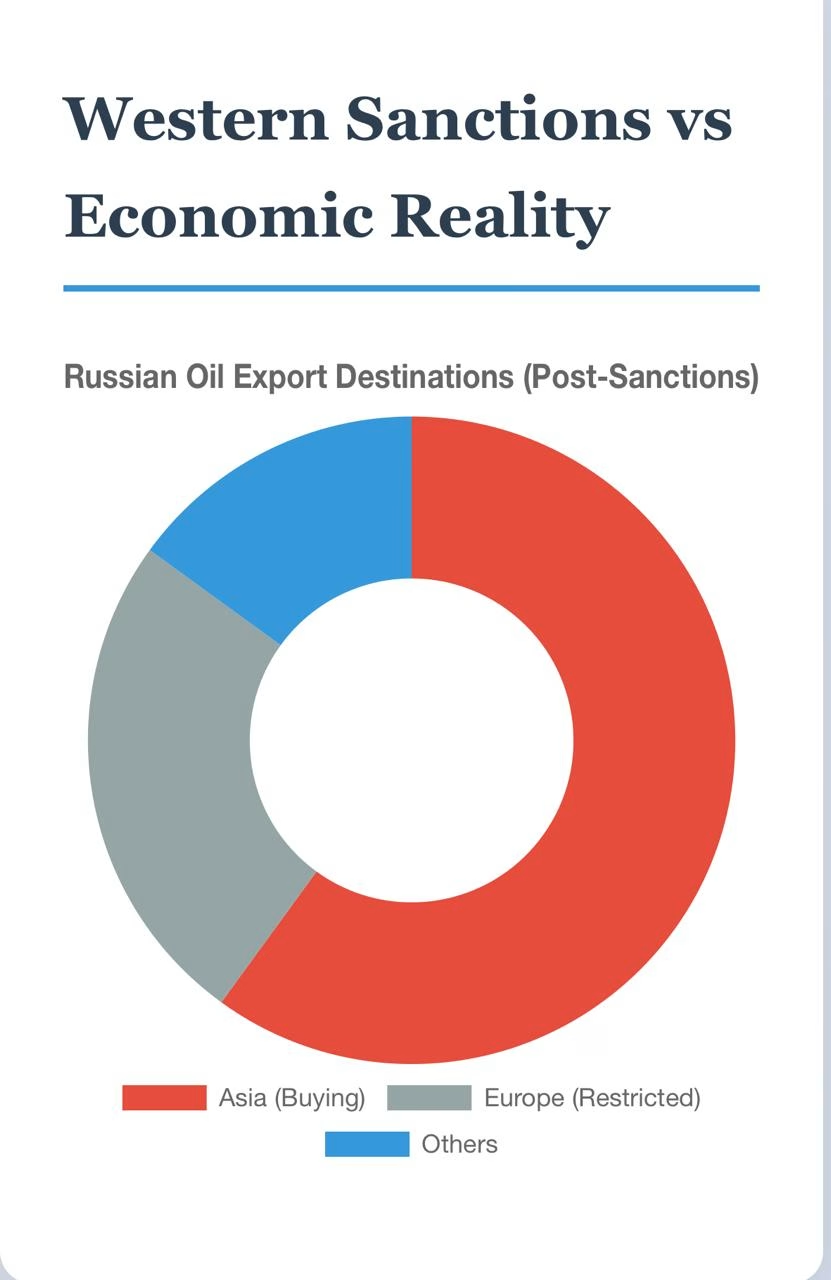
Since Russia’s 2022 Ukraine invasion, global oil trade has undergone its most dramatic transformation in decades. India emerged as an unlikely beneficiary, increasing Russian crude imports from negligible volumes to 1.6 million barrels daily—40% of total imports—generating $2.7 billion monthly savings through $15-20 per barrel discounts. Western sanctions triggered a 60% redirection of Russian exports from Europe to Asia within 18 months, enabling Moscow to earn $119 billion from oil sales in 2024. The crisis accelerated alternative payment systems bypassing Western financial infrastructure, while creating permanent market fragmentation along geopolitical lines that may outlast the conflict itself.
Trade, Tariff, Trump and Tremor
In the three years since Russia invaded Ukraine, the global oil trade has undergone its most dramatic transformation since the 1973 oil crisis. What began as Western attempts to starve Moscow of energy revenues has instead accelerated the emergence of parallel trading systems, alternative payment mechanisms, and new geopolitical alignments that may outlast the conflict itself.
Nowhere is this transformation more visible than in India’s energy relationships. The world’s third-largest oil importer has become an unlikely beneficiary of sanctions against Russia, importing heavily discounted crude that has reshaped both countries’ economic prospects. Yet this opportunistic relationship now faces mounting pressure from Western allies determined to close perceived loopholes in their sanctions regime.
The stakes extend far beyond bilateral trade. India’s choices will help determine whether economic sanctions remain effective tools of statecraft or whether large economies can route around them, creating a more fragmented but potentially more resilient global trading system.
India’s Calculated Bet
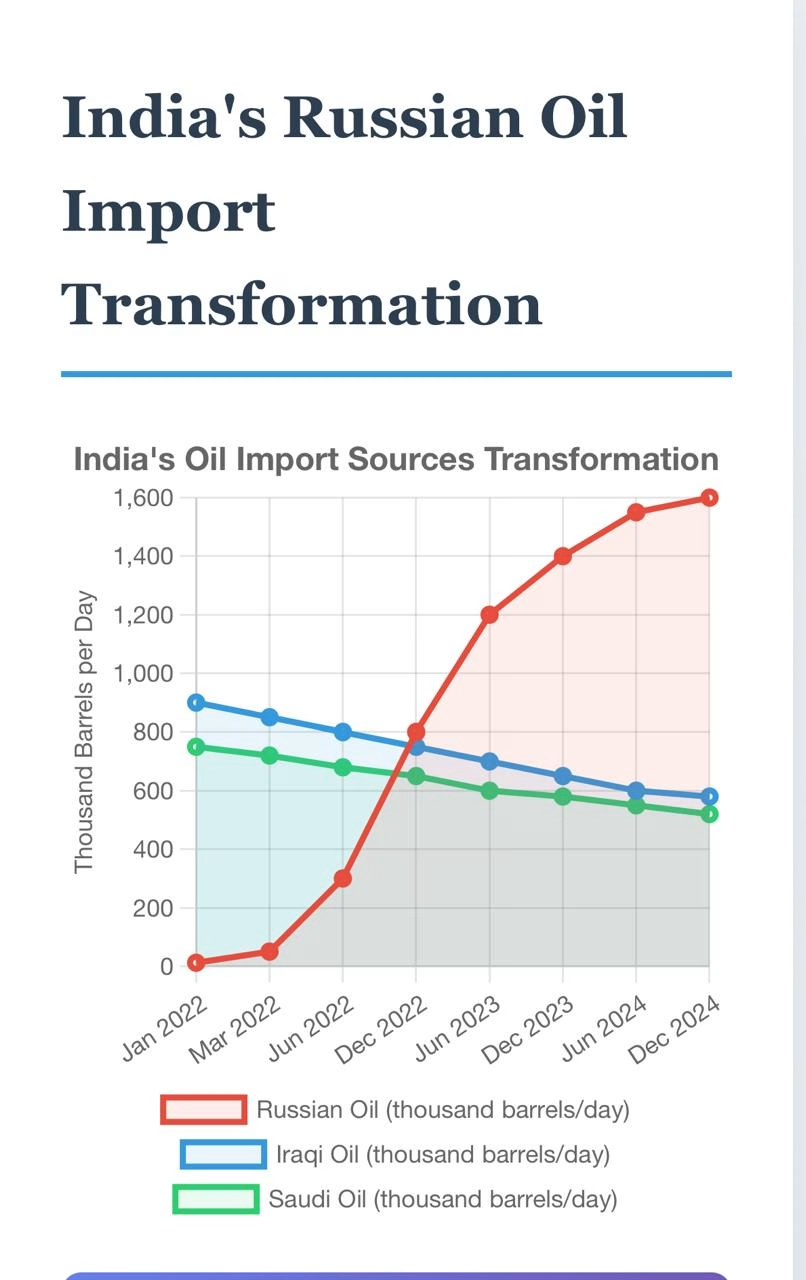
Before February 2022, Russia barely registered in India’s energy imports, supplying less than 1% of the country’s crude oil needs. Today, Russian oil accounts for nearly 40% of India’s imports—approximately 1.6 million barrels daily—making Moscow New Delhi’s largest energy supplier ahead of traditional partners like Iraq and Saudi Arabia.
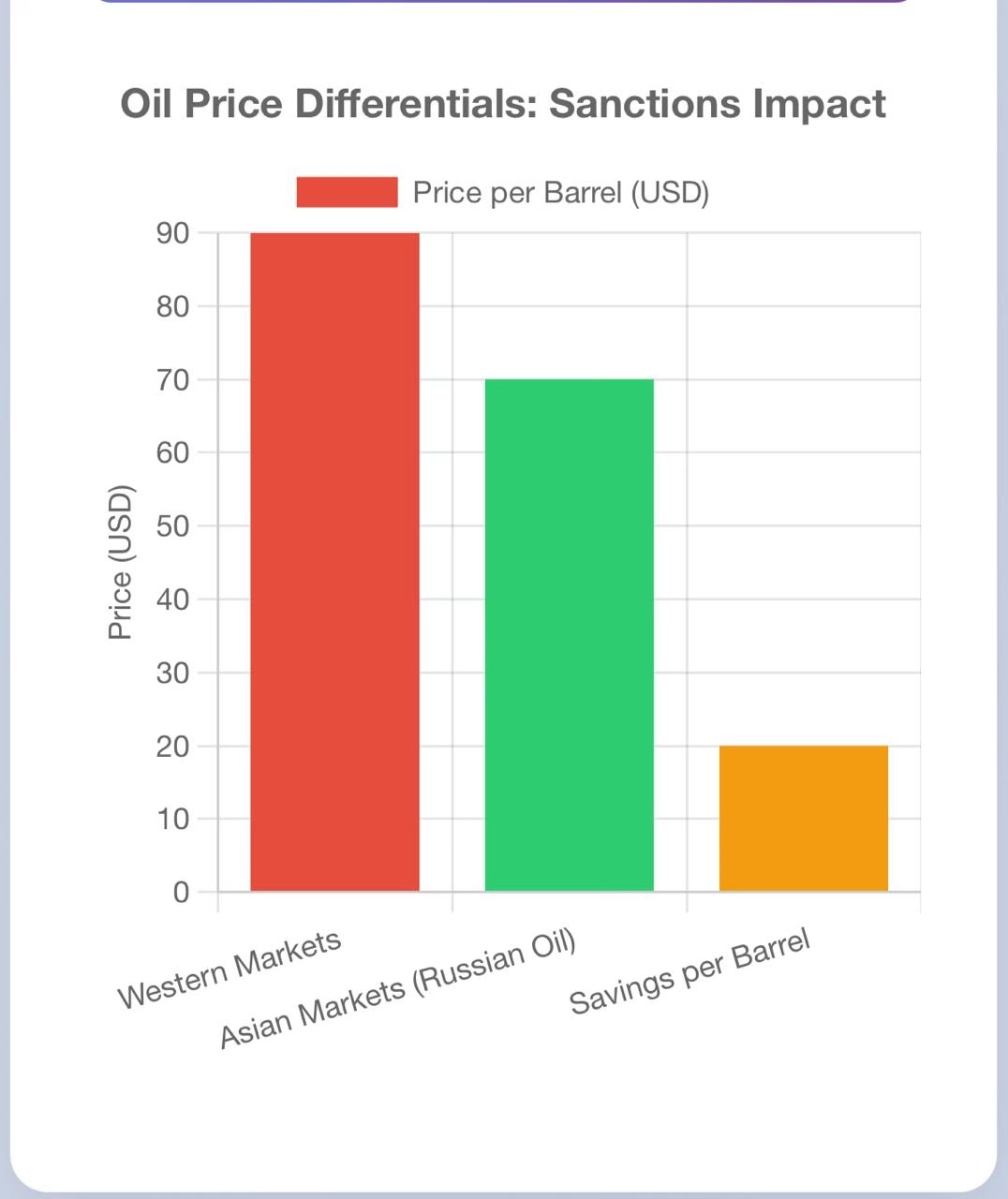
The arithmetic behind this shift is quite dramatic. Russia is offering discounts on its crude in the range of $12-18 below international benchmarks, generating monthly savings of roughly $2.5 billion for the Indian economy. For an emerging nation where the cost of energy directly impacts both household budgets and industrial competitiveness, such discounts prove difficult to resist.
Indian refineries, designed to process both heavy and sour crude which provide great flexibility to take advantage of this trade opportunity. The infrastructure compatibility, combined with substantial price advantages, more than offset any logistical complications or diplomatic strife.
Energy security as Indian economists and bureaucrats consistently argue, must transcend geopolitical preferences.
The Indian strategy, driven by its ever-rising appetite for energy, reflects broader market dynamics unleashed by Western sanctions. Russia’s desperate search for alternative buyers coincided with India’s perpetual quest for affordable energy supplies. A perfect match indeed particularly at a time when geopolitical divergence is getting wider leading to an indomitable stress on the world’s energy supplies.
Geography favoured this convergence—Russian oil finds Indian ports more easily than traditional suppliers in West Africa or Latin America, largely reducing transportation costs.
The Western Response
Washington’s reaction has been characteristically blunt and furious. In August 2025, the Trump administration surprisingly imposed 50% tariffs on a range of Indian exports, explicitly linking trade punishment to energy purchases from Russia. Administration officials made clear that continued Russian oil imports would trigger escalating economic retaliation, fundamentally altering the cost-benefit calculation for Indian policymakers. An act, which is seen as a violent attack, if not bullying, against one of the largest economies and democracies of the world.
European approaches proved more sophisticated but equally razor-blading. Rather than directly sanctioning India—a move that might have backfired diplomatically—Brussels targeted the downstream effects of Indian Russian oil purchases.
The EU banned imports of petroleum products refined from Russian crude by third countries, affecting $14.3 billion worth of Indian fuel exports to European markets.
This strategy acknowledged a crucial reality: India’s massive refining capacity allows it to import Russian crude, process it into diesel and other petroleum products, then export these refined goods globally. European sanctions aimed to eliminate this profitable arbitrage while avoiding confrontation with a strategically important partner.
Not only the country-alone approach. The EU also sanctioned Nayara Energy, India’s second-largest refinery, which processes 400,000 barrels daily of predominantly Russian crude through its 20% Russian ownership via Rosneft. The move exemplified how sanctions now target corporate structures and ownership patterns rather than simple trade flows, complicating business relationships across multiple jurisdictions.
Corporate Adaptations
Indian energy companies have begun recalibrating their strategies to avoid a political backlash. Reliance Industries, the country’s largest private refiner, has reportedly reduced Russian crude purchases considerably while turning toward Middle Eastern suppliers. Company executives privately acknowledge the transition carries substantial costs that ultimately flow through to consumers and shareholders.
Industry estimates suggest switching from Russian to alternative crude supplies increases processing costs by $3-4 per barrel. For state-run Indian Oil Corporation, which processes 1.5 million barrels daily, such increases translate to additional monthly expenses of $135-180 million. A figure that sends a tremor down the spine of energy economics.
The adjustment process has created market distortions. European buyers, anticipating stricter sanctions enforcement, stockpiled Indian diesel throughout 2025. with exports jumping 137% in August. This surge reflected buyer behaviour ahead of the January 2026 deadline when EU restrictions on Russian-origin refined products become fully effective, creating a final window for profitable arbitrage.
Some Indian companies have adopted more creative approaches. Ship-to-ship transfers in international waters allow Russian crude to blend with other supplies before reaching Indian ports, obscuring the source. Payment systems increasingly bypass traditional dollar-based mechanisms in favour of rupee-rouble arrangements that sidestep Western financial oversight.
Global Market Realignment
India’s experience reflects broader patterns reshaping global energy trade. China increased Russian oil imports by 24% in 2024 to 1.76 million barrels daily, while Turkey imported 200,000 barrels daily through various mechanisms. Brazil purchased Russian diesel through ship-to-ship transfers, avoiding direct bilateral trade relationships that might trigger secondary sanctions.
These countries collectively represent 45% of global GDP, illustrating the limits of Western economic pressure when applied to essential commodities like energy. Their continued Russian purchases enabled Moscow to redirect roughly 60% of oil exports from European to Asian markets within 18 months—a remarkable supply chain pivot executed under extreme duress.
Russia earned approximately $119 billion from oil exports in 2024, according to International Energy Agency calculations. While substantially below pre-war levels, these revenues demonstrate the challenges facing Western policymakers attempting to isolate Russian energy exports through market-based sanctions rather than physical blockades.
The redirection has created new trading relationships likely to persist beyond any eventual conflict resolution. Infrastructure investments in pipelines, port facilities, and shipping routes represent long-term commitments that will influence energy flows for decades. Market relationships, once established, prove remarkably durable even when their original rationale disappears.
Financial Innovation Under Pressure
Perhaps the most significant long-term consequence involves payment systems. Traditional dollar-based oil trading faces new complications as buyers seek sanctions-proof mechanisms for international commerce. India has developed rupee-rouble arrangements for some Russian purchases, while China conducts increasing energy trade in yuan.
The Reserve Bank of India approved rupee payments for commodity trades with 18 countries, including Russia and Iran. State Bank of India opened specialised Vostro accounts to facilitate these transactions, creating institutional infrastructure for non-dollar international trade. These mechanisms, initially designed to circumvent sanctions, may evolve into permanent alternatives to Western financial systems.
Such parallel payment systems represent potentially the most enduring challenge to Western economic dominance. Major economies are developing alternatives to dollar-based commerce not from ideological preference but from practical necessity. Once established, these systems may prove attractive to countries seeking reduced exposure to Western financial oversight and potential sanctions risks.
The trend accelerates broader concerns about “weaponisation” of the international financial system. If dollars and euros become unreliable for international commerce due to sanctions risks, rational actors will invest in alternatives. This process, once begun, may prove difficult to reverse even if current geopolitical tensions subside.
European Contradictions
Indian officials regularly highlight European energy imports from Russia as evidence of Western double standards that undermine sanctions credibility. Despite extensive rhetoric about isolating Russian energy exports, EU data reveals the bloc imported 15 billion cubic metres of Russian pipeline gas and 16.5 million tonnes of LNG in 2024—worth approximately €15 billion.
Hungary and Slovakia secured formal exemptions for Russian oil imports through the Druzhba pipeline, while Austria continues receiving Russian gas under long-term contracts. These arrangements contrast sharply with pressure on Asian buyers to immediately cease Russian energy purchases, creating apparent inconsistencies that complicate diplomatic messaging.
Such contradictions reflect practical realities about European energy infrastructure and supply alternatives. However, they also provide convenient arguments for countries like India to justify continued Russian purchases. If European nations maintain selective Russian energy imports while demanding complete Asian abandonment, the moral foundation for universal sanctions compliance weakens considerably.
These dynamics illustrate broader challenges in coordinating international sanctions among diverse economies with varying energy needs, infrastructure constraints, and political priorities. What appears as hypocrisy may actually reflect the complex compromises necessary to maintain alliance cohesion while pursuing economic pressure against target countries.
Industrial and Strategic Calculations
Indian refineries represent billions of dollars in infrastructure optimised for heavy, sour crude precisely matching Russian export specifications. Switching to lighter Middle Eastern alternatives requires different catalysts, processing units, and operational procedures that reduce efficiency and profit margins while potentially stranding existing investments.
The petroleum ministry projects Indian oil demand growing 3-4% annually through 2030, requiring additional imports of 500,000 barrels daily. Russian supplies currently meet roughly 40% of this incremental demand at competitive prices, making alternative arrangements both costly and logistically challenging given global supply constraints.
Alternative suppliers lack the spare capacity to replace Russian volumes seamlessly. Saudi Arabia and the United Arab Emirates operate near maximum sustainable production levels, while US shale output growth has decelerated from previous expansion rates. Iranian and Venezuelan oil face separate sanctions complications, further limiting India’s options for politically acceptable supplies.
The government has accelerated renewable energy targets to 500 gigawatts capacity by 2030, recognising that long-term energy security requires reduced dependence on volatile international oil markets. However, this transition requires decades while current energy needs remain immediate and growing, particularly for petrochemical feedstocks and transportation fuels that renewables cannot easily replace.
Market Structure Evolution
Global oil markets have effectively fragmented along political lines, creating structural price differentials that benefit countries accessing discounted supplies. Western nations pay premiums for “sanctions-compliant” oil while sanctioned producers sell at discounts to willing buyers, generating competitive advantages for economies able to navigate these restrictions.
The International Energy Agency estimates Western oil prices average $8-12 higher per barrel due to self-imposed supply constraints from avoiding Russian crude. This differential provides sustained competitive advantages for Indian and Chinese manufacturers while increasing costs for Western industrial production, potentially reshaping global manufacturing competitiveness over time.
Ship-tracking services reveal sophisticated circumvention methods as Russian oil reaches European buyers through ship-to-ship transfers, blending with non-Russian supplies, and processing through third countries before final delivery. These practices demonstrate market ingenuity in preserving commercial relationships despite political restrictions, suggesting that sanctions effectiveness may erode gradually through adaptive behaviour.
The emergence of “shadow fleets” operated by obscure shipping companies facilitates these transactions while providing plausible deniability for ultimate buyers. Insurance markets have adapted by developing separate coverage for sanctions-risk shipping, creating entire industries around regulatory circumvention that may persist beyond current geopolitical tensions.
Strategic Implications
India’s position exemplifies broader challenges facing middle powers in an increasingly polarised international system. Economic interests frequently diverge from geopolitical preferences, forcing difficult choices between immediate material benefits and longer-term strategic relationships. Energy security, always a national priority, has become inseparable from foreign policy positioning.
The country’s leadership consistently emphasises obligations to domestic consumers over international political solidarity. This stance resonates powerfully within India’s democratic system but complicates relationships with Western partners increasingly focused on isolating Russian revenue streams regardless of consequences for third-country economies.
For global governance, the Indian case illustrates limitations of economic sanctions when applied to essential commodities traded among major economies with alternative suppliers and payment systems. Sanctions work most effectively against isolated countries lacking market alternatives, not against major economies with diverse trading relationships and sophisticated financial systems.
The precedent may influence future sanctions design and effectiveness. If large economies can successfully route around restrictions through alternative suppliers, payment systems, and corporate structures, sanctions become primarily symbolic gestures rather than effective policy tools for influencing target country behaviour.
Future Trajectories
Resolution of current tensions likely involves gradual evolution rather than dramatic policy reversals. Indian energy companies will slowly diversify supply sources while maintaining Russian relationships where commercially advantageous and politically feasible. Payment systems and trading mechanisms developed during the sanctions period may persist as permanent alternatives to Western-dominated financial infrastructure.
The global energy system emerging from this crisis will likely prove more fragmented but potentially more resilient than the integrated markets that characterised the post-Cold War era. Multiple trading blocs, payment systems, and supply relationships may replace the simplified patterns of recent decades, creating both opportunities and risks for energy security worldwide.
Energy security calculations will permanently incorporate sanctions risks alongside traditional considerations of price, supply reliability, and transportation logistics. Countries will invest in diversified supply sources and alternative payment mechanisms not from current necessity but as insurance against future geopolitical disruptions that might affect their access to essential commodities.
The transformation extends beyond energy into broader questions about economic interdependence, alliance relationships, and the role of sanctions in international relations. What began as temporary measures to pressure Russia over Ukraine may accelerate longer-term shifts toward a more multipolar, fragmented global economy where political considerations increasingly override pure economic efficiency.
In this new landscape, energy remains power—but the pathways through which that power flows have become far more complex, contested, and consequential than ever before.
The author is the former Executive Director of Oil and Natural Gas Corporation (ONGC).
He is the Founder and Editor-in-Chief of Newscript Energy World