Executive Summary
India’s energy sector in 2025 reflects rapid diversification and new challenges.
Oil and gas remain central, but import dependence has pushed focus toward **LNG imports India** and diversified crude sourcing.
**Coal production India** surpassed one billion tonnes, ensuring supply security, though transport infrastructure constraints persist.
**Renewable energy in India** posted record growth, with rooftop solar and wind gaining momentum alongside major policy changes such as the removal of pooled tariffs.
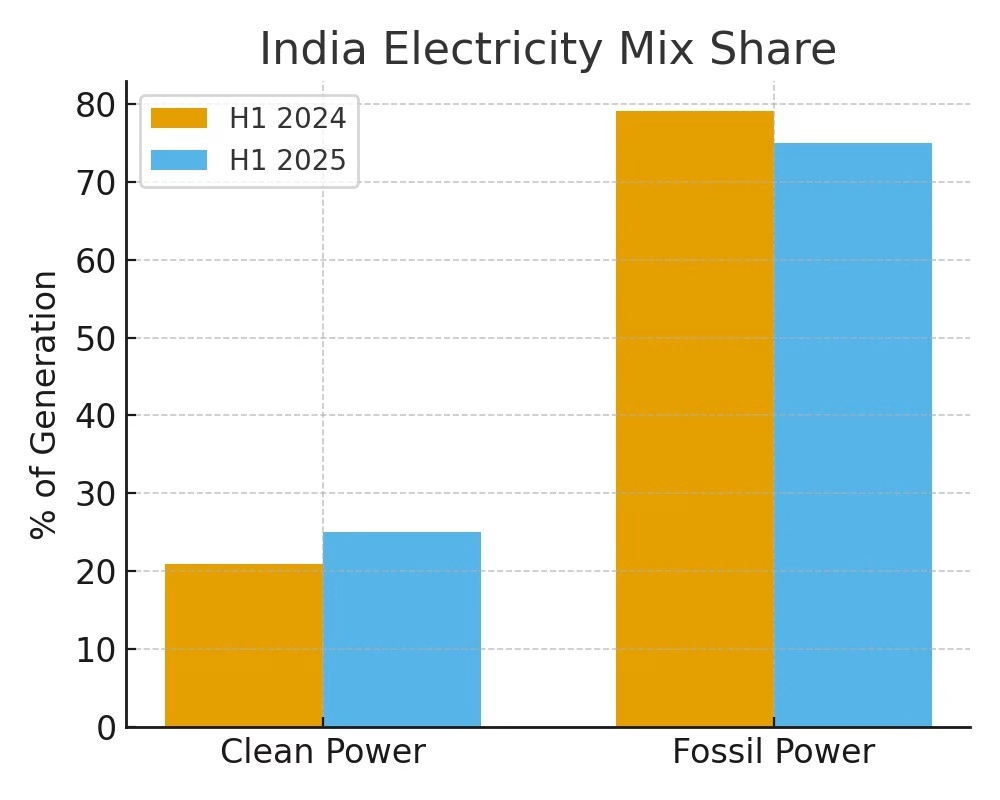
Clean electricity accounted for 25% of generation in H1 2025.
Meanwhile, **climate change impact India** intensified, from devastating monsoon floods to record internal displacements and worsening heat stress.
The Sundarbans and India’s coastline highlight urgent adaptation needs.
This briefing provides category-wise updates on Oil & Gas/LNG/Coal, Renewables, and Climate, offering policymakers, investors, and researchers a consolidated view of the **India energy transition** and climate risks.
Table of Contents
- Category 1: Oil & Gas, LNG & Coal
- Category 2: Renewables
- Category 3: Climate
Category 1: Oil & Gas, LNG & Coal
BPCL locks five‑month U.S. crude deal
Bharat Petroleum has awarded a five‑month tender for about 10 million barrels of U.S. crude, largely WTI Midland, to Glencore for November–March deliveries.
The move deepens India’s diversification beyond the Middle East and Russia, reducing sanctions and pricing risk while keeping refineries supplied with light sweet crude.
It also aligns with New Delhi’s drive to broaden energy ties with Washington.
With India importing nearly 90% of its crude, the pivot to U.S. grades has become structural in 2025, supported by competitive pricing and ample U.S. export capacity.
India maps a bigger LNG gateway by 2030
India plans to expand **LNG imports India** capacity by 27% to 66.7 mtpa by 2030, adding two new terminals to the existing eight as it targets gas at 15% of the energy mix (up from about 6% today).
Upgrades include converting Ratnagiri (Dabhol) into an all‑weather terminal and expanding city‑gas networks.
The strategy underpins industrial fuel switching, fertiliser feedstock security and grid balancing for renewables.
It also positions India to capture the upcoming global LNG supply wave as new liquefaction trains come online mid‑decade.
Coal tops 1 billion tonnes—pressure shifts to logistics
**Coal production India** exceeded one billion tonnes in FY2024–25, with Coal India leading output and rail dispatches rising.
This milestone has stabilised power plant stocks ahead of another high‑demand summer.
However, bottlenecks are now in logistics: evacuating coal during monsoon and heatwaves remains a challenge.
Government plans still include coal capacity through the 2030s to back up renewables, though the focus is on efficient supercritical units and faster rail turnaround.
The next challenge is balancing energy security with emission reduction as clean generation gains share.
NTPC shutters ageing Tanda‑I (440 MW)
NTPC has permanently closed the four 110‑MW units at Tanda Thermal Power Station Stage‑I in Uttar Pradesh, effective September 1.
Retiring small sub‑critical units cuts fixed costs and frees capital for supercritical coal, pumped storage and renewables under NTPC Green Energy.
The closure reflects a broader national trend of phasing out inefficient plants while tightening emissions norms.
Grid impact is limited given new renewable additions, though local dispatch will adjust as nearby supercritical plants take over baseload supply.
Category 2: Renewables
Centre scraps pooled renewable tariffs to unlock deals
The power ministry has abolished pooled solar and hybrid tariffs, introduced in 2024 to standardise three‑year prices.
Developers argued the scheme slowed power‑sale agreements.
Reverting to project‑wise price discovery is expected to clear a large backlog of projects awaiting contracts.
This policy shift recognises the diversity in project costs across states and will accelerate commissioning as India races toward its 500‑GW non‑fossil target by 2030.
Clean electricity sets a new H1 record
India generated 236 TWh of clean electricity in the first half of 2025, about 20% higher year‑on‑year, reducing fossil generation by 4%.
Wind rose 29% and solar 25%, with hydro and nuclear also strong.
Clean power averaged 25% of supply and reached 31% in June, the highest ever.
This shift shows how rapidly **renewable energy in India** is scaling and highlights the need for expanded green corridors to deliver power efficiently to demand centres.
Chart 1: India Electricity Mix Share (H1 2024 vs H1 2025)
Rooftop solar finally scales
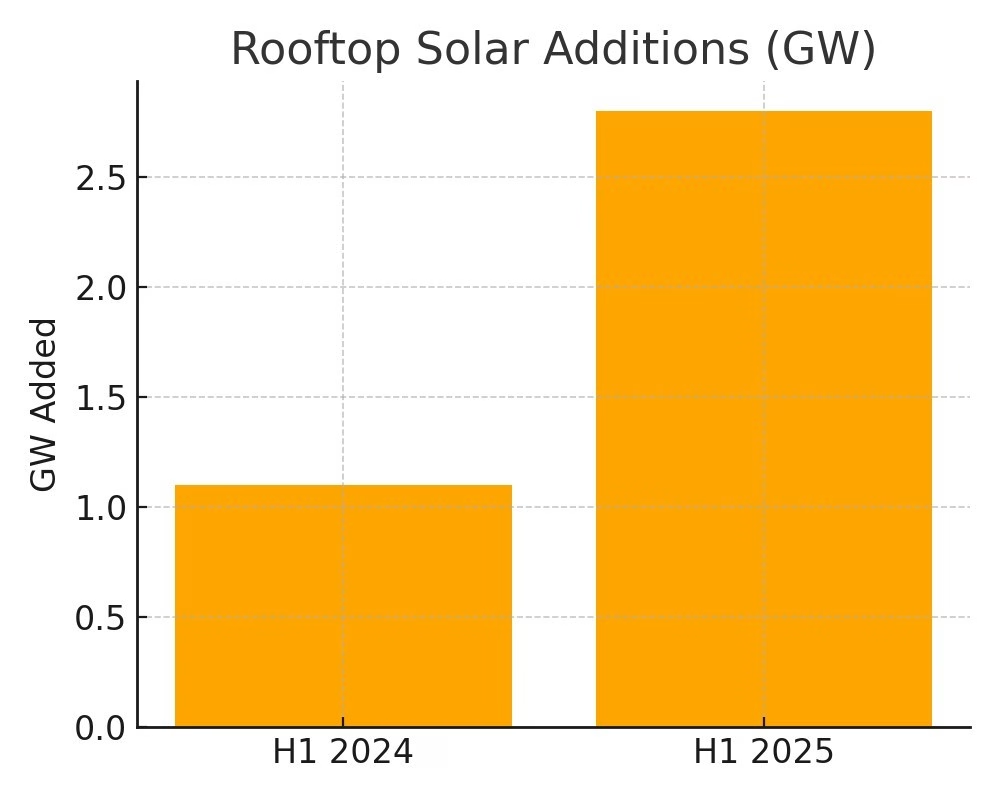
Rooftop solar capacity rose 2.8 GW in H1 2025, up 158% year‑on‑year, driven by PM Surya Ghar and faster subsidy disbursals.
Households accounted for the bulk of growth, with Gujarat, Maharashtra, Uttar Pradesh, Kerala and Rajasthan leading.
The surge is widening India’s distributed generation base, easing grid peaks and sparking demand for behind‑the‑meter storage.
Challenges remain around net‑metering limits and DISCOM approvals, but consumer adoption momentum is now strong.
Chart 2: Rooftop Solar Additions
Market signals: exchange volumes jump
The Indian Energy Exchange traded 11.8 billion units in August, up 19% year‑on‑year, with 2.16 million renewable energy certificates exchanged.
The rebound signals rising industrial demand and confidence in short‑term procurement.
For developers, deeper day‑ahead liquidity and stronger REC pricing support hybrid portfolios and merchant strategies.
Category 3: Climate
Monsoon floods test the North’s defences
Relentless late‑monsoon rain pushed rivers above danger levels in Delhi, Punjab and Kashmir, leading to evacuations and crop losses.
Landslides in Himachal cut roads and hampered hydropower operations.
Scientists link the severity to altered western disturbances under global warming.
The floods highlight the urgent need to strengthen urban drainage and early‑warning systems as extreme rainfall becomes more frequent.
Heat stress becomes an economy‑wide risk
Extreme heat now threatens more than half of India’s districts, covering nearly three‑quarters of the population.
Rising wet‑bulb temperatures increase risks for the urban poor and outdoor workers.
Cooling demand is pushing power peaks earlier in summer, straining grids.
Heat‑action plans are expanding, but implementation remains uneven.
Designing cities with passive cooling and stronger tree canopies will be critical to adapt to the **climate change impact India** is already facing.
Climate displacement is no longer abstract
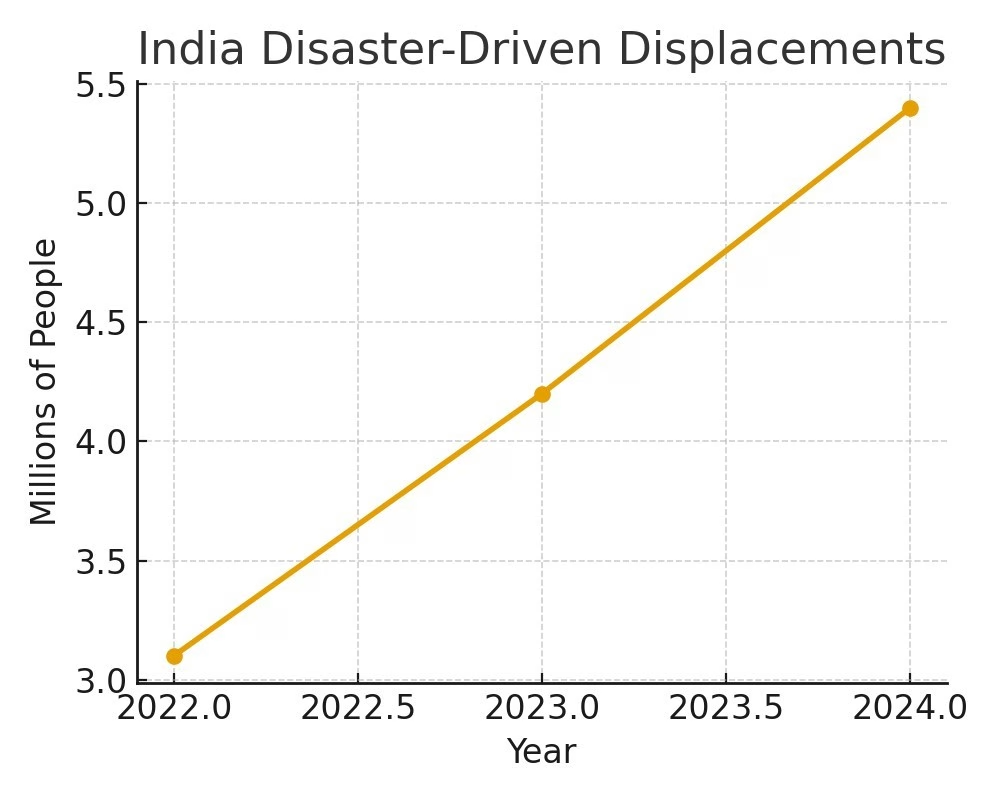
India recorded 5.4 million disaster‑related displacements in 2024, the highest in over a decade.
Floods were the main driver, though drought and heat are emerging causes.
Pre‑emptive evacuations are saving lives but are straining urban services when people cannot return quickly.
Policy is shifting towards portable entitlements, resilient housing, and planned relocation to address recurrent displacement.
Sundarbans: the creeping coastal squeeze
Sea‑level rise, storm surges and salinity are reshaping the Sundarbans, threatening mangroves, agriculture and aquaculture.
Communities are adapting with salt‑tolerant crops, raised housing and mangrove restoration, but protection gaps remain.
Cyclones tracking further inland expose vulnerabilities, underscoring the urgency of coastal protection and nature‑based solutions.
Chart 3: Disaster Displacements in India