
Newscript, August 5, 2025
By Pallab Bhattacharya
Introduction
A silence hung over India’s financial markets the morning after President Donald Trump’s announcement. Then came the tremor.
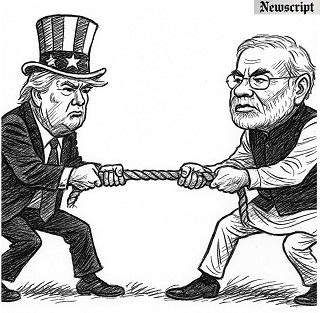
Starting August 7, Indian exports to the United States—worth nearly $87 billion—will be slapped with a blanket 25% tariff, a fourfold jump from the average 2024 rate. From artisanal shawls in Kashmir to iPhones assembled in Chennai, the imposition cuts across every sector of India’s export machinery. What’s at stake is not just commerce—but a hard-won strategic equation that has defined India–US relations for over three decades.
This is not the first time trade has been weaponised by Washington. But for India, the timing is unprecedented. Just as it emerged as a China+1 manufacturing hub, opened its markets to global capital, and began reshaping defense partnerships—Trump’s tariff order has delivered a jolt that could set back years of diplomatic progress.
“This is not about trade. This is about trust—and testing the depth of India’s sovereignty,” said a senior Indian trade negotiator under condition of anonymity.
The move, widely seen as retaliation for India’s energy ties with Russia and vocal BRICS alignment, has plunged the world’s two largest democracies into their most serious trade rift since India’s 1991 liberalisation reforms.
A Trade Relationship Forged in Reform
India’s post-1991 economic reforms fundamentally altered the trajectory of its relationship with the US. Tariffs exceeding 80% in 1990 fell sharply to 39% by 1996. Non-tariff barriers dropped from 87% to 45% of tariff lines within five years. Bilateral trade, long stagnant, surged—with exports growing 13.74% and imports by 27.71% in the early 1990s.
The United States actively supported India’s liberalisation, working with international financial institutions to provide administrative and technical assistance. By 2012, trade accounted for more than half of India’s GDP. Today, the US is India’s largest trading partner, with bilateral trade reaching $131.84 billion in 2024–25.
Why Trump Escalated the Trade War
The Trump administration’s new tariff regime stems from a mix of geopolitical resentment and economic grievance. India’s continued crude imports from Russia—viewed as a violation of Western sanctions—sparked the anger. Further irritation came from India’s growing voice in BRICS, which Trump views as antagonistic to the Western-led economic order.
The US trade deficit with India—standing at $45.7 billion in 2024—provided the economic justification. But Trump’s framing was unequivocal: India, he claimed, was ‘profiting from war’ and ‘cheating on tariffs and immigration’. White House aides reinforced the moral tone, accusing India of hypocrisy and opportunism. The tariffs, effective August 7, represent a dramatic 18.3 percentage point spike from the 2.4% effective rate in 2024.
India Pushes Back: ‘Unjustified and Unreasonable’
India’s Ministry of External Affairs issued a sharply worded statement calling the tariffs “unjustified and unreasonable.” It highlighted that Indian oil purchases from Russia were driven by ‘market compulsions’ following Europe’s redirection of energy flows.
Commerce Minister Piyush Goyal has since held multiple rounds of diplomatic talks with US Secretary Howard Lutnick. While maintaining a calm diplomatic tone, Goyal emphasized India’s desire for ‘fair and balanced’ engagement.
Opposition parties, however, were less restrained—criticizing Prime Minister Modi for his ‘silence’ and accusing the government of strategic passivity.
The Economic Blowback
Make in India Momentum Amid Turbulence
In response to the tariff escalation, Prime Minister Narendra Modi reiterated his call for strengthening India’s self-reliant manufacturing capabilities. Speaking at a recent public address, he urged citizens and industries alike to embrace Swadeshi goods and reaffirm the spirit of ‘Make in India.’ Modi emphasised that the current global scenario is a reminder that India must reduce over-dependence on any single country or market. He called upon domestic manufacturers, artisans, and entrepreneurs to seize this moment as an opportunity to innovate, invest, and scale globally competitive products. The call aligns with India’s larger economic strategy of Atmanirbhar Bharat and aims to insulate Indian industries from global supply chain shocks while enhancing export competitiveness.
Goldman Sachs now forecasts India’s GDP growth at 6.5% in 2025, down from 6.8%. Nomura estimates a 0.2% drag. Sujit Kumar of NABFID calculates that the new tariffs could result in $16–18 billion in annual losses to Indian exporters.
Industries most affected include textiles, electronics, industrial machinery, and gems. MSMEs—especially in Tamil Nadu, Gujarat, and West Bengal—face rising costs, job losses, and shrinking margins. Layoffs could ripple across rural and semi-urban India, disrupting already fragile consumption demand.
Beyond Trade: Strategic Partnership Under Strain
The economic dispute threatens to bleed into defense and technology cooperation. Joint ventures in semiconductor manufacturing, military hardware procurement, and cyber cooperation could face bureaucratic delays.
Security analysts warn that this episode may erode American willingness to transfer sensitive defense technologies. A former Army Chief described Trump’s move as ‘economic coercion’ undermining ‘strategic trust’ built over two decades.
India’s Strategic Choices
India has so far avoided retaliation, focusing instead on damage control. Policymakers are considering increasing LNG and agricultural imports from the US to demonstrate goodwill.
Trade diversification is also being accelerated—with renewed efforts to boost ties with ASEAN, the EU, and the Gulf. Structural reforms to lower India’s own tariffs and simplify NTBs are back on the table.
Economists like Govinda Rao have long argued that protecting agriculture—only 16–18% of GDP—should not come at the cost of global competitiveness.
A Multipolar World and the Unmaking of Trade Consensus
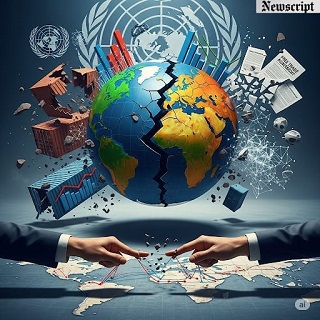
The tariff episode reflects a larger unraveling of the post–Cold War economic consensus. Multilateralism is giving way to hard-nosed transactionalism.
India’s emergence as a balancing power—between East and West—puts it in the crosshairs. Whether New Delhi can assert its sovereignty while preserving economic momentum remains the critical test.
The Path Forward
Despite heightened friction, India and the United States remain economically interdependent and strategically aligned. India’s market of 1.4 billion people, its innovation ecosystem, and geopolitical positioning continue to be vital to American supply chain and Indo-Pacific strategies. For India, U.S. capital, technology, and market access remain crucial pillars for sustained high-growth ambition.
The $500 billion trade target by 2030 now hinges on a calibrated rebalancing of interests. Navigating this moment will require deft diplomacy, economic vision, and the ability to insulate long-term strategy from short-term politics. The deeper question, however, extends beyond tariffs and deficits. It is about whether the world’s two largest democracies can forge a partnership resilient enough to weather the pressures of a multipolar global order.
This is India’s moment to demonstrate that economic sovereignty and global collaboration are not mutually exclusive. In doing so, it will redefine the very grammar of 21st-century trade, trust, and transformation.