
By Pallab Bhattacharya
Newscript | August 6, 2025
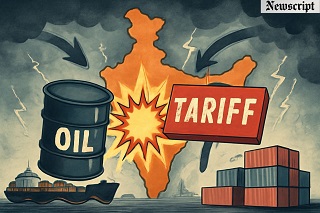
Oil prices are rising. The rupee is falling. And India’s central bank is walking a policy tightrope.
All it took was a fresh burst of tariff threats from former US President Donald Trump, this time aimed squarely at India, to jolt global commodity and currency markets. As of August 6, 2025, Brent crude hovered around $69 per barrel—rebounding from five-week lows—while the Indian rupee slumped 1.18% against the dollar in a single week. Foreign exchange reserves fell sharply by $9.3 billion to $688.9 billion.
For a country importing over 89.1% of its crude oil needs, this is more than noise. With domestic production languishing at roughly 573,000 barrels per day, against consumption of over 5.05 to 5.3 million barrels per day, global oil shocks translate almost immediately into economic strain.
The Reserve Bank of India (RBI) now finds itself squarely in the spotlight. On August 6, RBI Governor Sanjay Malhotra held the policy repo rate steady at 5.5% and maintained a neutral stance—despite inflation cooling to 3.1%. A phased cut in the Cash Reserve Ratio (CRR) from 4% to 3%, beginning September, was the central bank’s sole liquidity signal.
India’s crude oil import bill stood at $137 billion in FY25. When petroleum products are included, the total import burden reached $161 billion—an outsized sum that has direct implications on inflation, current account deficits, and currency stability. The dominance of imports leaves little cushion for global market tremors.
The impact of tariffs—should they be enacted—could be two-fold. Firstly, retaliatory trade actions might shrink India’s trade surplus with the US (which climbed from $21 billion in FY2015 to $41 billion in FY2025), affecting dollar inflows. Secondly, the tariff-induced sentiment shock has already caused capital outflows from equity markets. On August 1, the Nifty 50 slid 0.3% to 24,649.55, while the Sensex lost 0.38% to close at 80,710.25.
While Russia still accounts for nearly 36–40% of India’s crude imports, diversification is clearly underway. US crude imports jumped 51% year-on-year to 271,000 barrels per day in H1 2025, while imports from Brazil surged 80% to 73,000 barrels per day. These moves are part of New Delhi’s broader hedging strategy.
India’s Strategic Petroleum Reserve (SPR), comprising 5.3 million tonnes of crude oil capacity, provides some buffer—covering roughly 12–15 days of consumption. But the SPR is more insurance policy than solution.
RBI’s August 6 policy announcement offered an implicit admission of policy constraint. With a cumulative 100 basis point rate cut since February 2025 and inflation easing below target, the central bank might have been expected to ease further. Yet it held.
Governor Malhotra explained: “Very little policy room is left to support growth. Current macroeconomic conditions and uncertainties call for continuation of the repo rate at 5.5%.”
That decision also reflects global spill overs. Tariff tensions, along with volatile oil prices, have upended the growth-inflation calculus. India’s GDP is still expected to grow at 6.5% in FY26, but downside risks have sharpened.
Even as RBI prepares to inject liquidity via phased CRR cuts, it is cautious. The banking sector’s fundamentals remain strong—capital adequacy at 17%, net interest margins at 3.5%, and liquidity coverage at 132%. But monetary transmission has been uneven. Fresh rupee loan rates have declined only 71 basis points despite a 100 bps policy rate cut.
The immediate effect of monetary conservatism is felt in deposit and lending markets. With rates held steady and inflation easing, real returns on fixed deposits have marginally improved. However, market-linked investments—especially equity mutual funds—may face headwinds if volatility persists.
Debt mutual funds are likely to benefit from a stable interest rate environment. Meanwhile, gold—traditionally seen as a safe haven—has surged 7.6% in the past month, with demand rising among retail investors spooked by global uncertainty.
The real estate sector could also see mixed signals. On one hand, stable rates support affordability. On the other, global uncertainty and capital flight may reduce developer liquidity and raise borrowing costs in the medium term.
Energy policy experts suggest India’s best response is structural, not tactical. Long-term diversification—both in source countries and energy mix—is underway but slow. Natural gas consumption is expected to grow 60% by 2030, reaching 103 bcm annually. Renewables, including solar and wind, have seen strong momentum, but fossil fuels will dominate India’s energy mix for the foreseeable future.
The current volatility only underscores the need to accelerate transition pathways. More robust grid storage, domestic exploration incentives, and clearer pricing for renewables are essential.
This moment may well be a turning point. As India stares down the dual threats of trade wars and oil price shocks, its policy architecture—from RBI’s calibrated restraint to the government’s energy strategy—will be tested.
India is no stranger to external volatility. But its growing geopolitical role and rising energy appetite make this trade-oil shock far more consequential. The balance between diplomacy, diversification, and domestic resilience will determine whether India weathers the storm—or gets pulled into the undertow of a turbulent global order.