
Twenty years on, memory still haunts! On 26th July 2005 , the day began in the usual way. Sky was overcast, Air was thickened with moistures. By afternoon, the rain changed its voice.
“The first 20 minutes were just a downpour. By 3 p.m., it sounded like the sky had cracked,” remembers Rekha Patil, a schoolteacher from Kandivali, whose students were trapped in their classroom until the next morning. “The school bell never rang that day. But every other alarm in the city went off—too late.”
It was July 26, 2005. . By midnight, Mumbai had recorded an unprecedented 944 mm of rainfall, the highest 24-hour total in India’s meteorological history at the time, according to the IMD’s post-season bulletin. Most of it—709 mm—fell between 2:30 p.m. and 7:30 p.m. An unthinkable monsoon fury. The city, built on dreams and landfill, began to drown. Trains stopped. Buses floated. Electricity failed. In the slums of Kurla and Govandi, brown water rose up to windows. Manholes turned into traps. Entire families clambered onto tin roofs, soaked and silent.
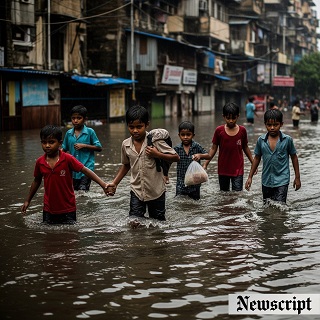
“I saw a boy, five maybe, vanish into the current near Shivaji Nagar,” said Bapu Salve, a volunteer with a local housing society. “All of us screamed. And we were traumatised.”
The boy may have been Vishal Pardi. May not. But a mother, Asha Pardi, still lights a diya every year at the spot her son disappeared. His body was never recovered. Like hundreds of others.
Official death tolls vary: the Maharashtra state gazette puts the number at 1,094 across the state, with over 450 in Mumbai city. Newspaper estimates suggested the toll might have been higher. What is clear is that this was more than a weather event—it was a civic catastrophe.
When the Defenses Gave Way
Mumbai’s stormwater drainage system, designed in the early 20th century, could handle just 25.12 mm per hour. A project to double that capacity—known as BRIMSTOWAD—was drafted in 1990 by U.K. consultants and priced at ₹600 crore. The BMC shelved it as “financially unviable.”
That decision aged poorly.
On July 26, the city’s 105 drainage outfalls became open mouths drinking the Arabian Sea. Only three had floodgates. The rest let seawater in during high tide, flooding low-lying areas like Kalina, Saki Naka, and Mahim.
The Mithi River, choked by encroachments and industrial sludge, became a backflowing serpent. It breached its banks near the Bandra-Kurla Complex, submerging entire colonies. The city’s prime business location saw office people, wanting to go back homes, scampering for a shelter. Waters rose faster than panic.
The Chitale Committee, formed in the flood’s aftermath, noted that “land development had seriously compromised the city’s ability to absorb rainfall.” It recommended a mix of engineering fixes and ecological restoration. Few were implemented in full.
The Climate Underneath
While the word “climate change” rarely appeared in 2005 reports, two decades later, the scientific consensus is unequivocal: the deluge was not just a local failure. It was a harbinger.
Retrospective studies by the Indian Institute of Tropical Meteorology have linked the 2005 event to warmer-than-average Arabian Sea surface temperatures, which fed more moisture into the monsoon system. The IPCC’s Sixth Assessment Report underscores that extreme rainfall events in South Asia are now “very likely” to become more intense due to global warming.
Mumbai’s own heat island effect likely exacerbated the storm, with vertical concrete development trapping heat and moisture above the suburbs. Climate, it turns out, was the quiet accomplice.
Warnings That Weren’t Heard
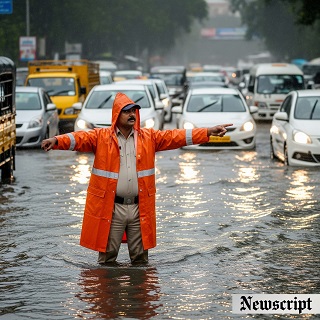
Disaster management that day was, at best, ad hoc. At worst, nonexistent.
The BMC control room was overwhelmed. The state’s Disaster Management Group met late in the afternoon—ironically to discuss flooding in Ratnagiri and Raigad. Meanwhile, Western Railway’s GM M.Z. Ansari publicly confirmed there was “no advance alert” from meteorological officials.
Sanjay Gandhi National Park staff reportedly made frantic calls to Mantralaya as early as 1:30 p.m., warning of unprecedented rainfall. Their calls went unreturned.
“By 4 p.m., we were watching live drowning,” said a junior officer from the State Police Control Room. “But we had no boats. Just walkie-talkies and umbrellas.”
Voices from the Streets
By evening, even the railways—Mumbai’s iron arteries—had ground to a halt. Over 150,000 commuters were stranded at platforms and stations, some walking 20 km through flooded streets. “At Dadar, we formed a human chain just to wade across the footbridge,” recalled Santosh Kadam, a railway porter.
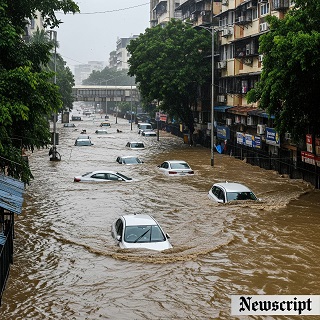
The smell of diesel, sewage, and fear hung thick in the air. On the Western Express Highway, headlights glowed underwater like ghost lanterns.
And yet, the people showed up for one another.
Chawl residents in Parel passed dry chapatis across balconies. Chemists opened shutters to distribute paracetamol. A Sikh gurudwara in Sion served 10,000 hot meals that night.
Mumbai’s famed “spirit” held. But it held because it had to—not because the system deserved it.
Twenty Years Later, What Has Changed?
By 2025, drainage capacity has improved. The BMC now claims its upgraded system can handle up to 50 mm/hour. Several pumping stations, including Love Grove and Haji Ali, are operational. The ₹1,000 crore flood mitigation fund, allocated in 2023, has been partially deployed, per state budget documents.
Early warning systems have been digitized. The Mumbai Disaster Management Cell runs regular simulations. The Indian Meteorological Department now issues hyperlocal rainfall alerts every 15 minutes.
Yet the city floods every monsoon.
On July 21, 2024, the IMD reported 308 mm of rainfall in a single day. Kurla, Andheri, and Ghatkopar saw waist-deep water. The response was faster—but the panic was the same.
Satellite data show that built-up land in the metro region has grown by 134% between 2000 and 2015. Mangrove cover continues to decline. In 2020, the BMC greenlit the felling of 9,000 mangroves for the coastal road project—ignoring the Chitale Committee’s red flags.
The 2014 Maharashtra State Action Plan on Climate Change warns: “Even with expanded drainage, a recurrence of 2005 rainfall levels would inundate large sections of Mumbai’s vulnerable zones.” UNEP and WMO now rank Mumbai among the top 10 coastal cities globally at risk from compound flooding.
The Price of Forgetting
For every new pump and drone alert, there is an old wound unhealed.
In Kurla, a wall mural depicts a drowning child and reads: “Don’t wait for the next flood to remember me.”
In Govandi, Asha Pardi still waits.
“I never saw his body,” she says. “But I see him in the flood every year. He comes back with the rain.”
Her grief, unlike like the monsoon, is not-seasonal. It’s permanent.
And her question lingers: “If the city had cared before it broke, would my son still be here?”
That, perhaps, is the real legacy of July 26—not just broken roads and shattered homes, but the quiet burden carried by those left behind.
As Mumbai stands at a crossroads—between resilience and retreat, between denial and design—the next cloudburst won’t ask for dir
ections. It will simply come. And the question won’t be “if,” but “how much worse?”