
It began like any other monsoon morning in Bengal’s heartland—quiet, muggy, and deceptively calm. The sky hung low, layered with haze, as farmers in Bankura, East Bardhaman, and West Medinipur stepped barefoot into their fields. They had work to do—transplanting paddy, checking irrigation lines, feeding livestock—before the next round of rain. By mid-morning, the clouds thickened into a metallic mass. At 11:10 a.m., the first bolt of lightning fell. Within hours, the fields turned into sites of loss. By 2:50 p.m., eighteen men lay dead. There was no flood. No cyclone. No warning loud enough to be heard. Just a sky that cracked wide open, and didn’t close in time.
It did not crackle. It did not warn. It sliced.
By 2:50 p.m., eighteen men were dead—struck down by lightning in the very fields that fed their families. The storm had passed. The sun returned. But the silence it left behind was not the silence of weather. It was the silence of absence.
A Sky That Knows Where to Strike
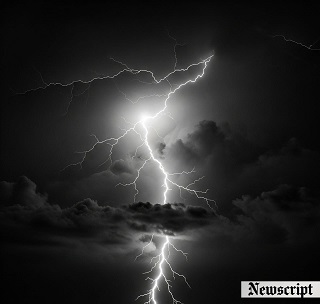
This was not a cyclone. There were no winds uprooting trees, no rivers spilling into towns. This was lightning—precise, fast, and increasingly deadly. According to the India Meteorological Department, the most concentrated activity occurred between 11:10 a.m. and 2:50 p.m., with Bankura experiencing the worst between 12:10 and 2:30 p.m.
The State Disaster Management Control Room in Kolkata confirmed the deaths the next morning: 9 in Bankura, 6 in East Bardhaman, and 3 in West Medinipur. Initial reports had cited as few as 13 and as many as 21, but 18 was the final, confirmed toll. All victims were men. All were working outdoors.
Warnings Issued, Unheard
At 9:45 a.m., nearly ninety minutes before the first strike, the Regional Meteorological Centre issued a now-cast bulletin: thunderstorms with lightning likely across parts of South Bengal. The Damini app, developed by the Ministry of Earth Sciences, began sending location-based alerts within a 20-kilometer radius of active strikes.
But warnings are only useful when they arrive somewhere. In these districts, network coverage is spotty. Smartphone penetration is inconsistent. Digital literacy, even more so. Few in the fields that day had phones. Fewer still were likely to understand the significance of a push notification if one arrived.
The Flash That Keeps Returning
Lightning is now India’s most prolific natural killer. In 2022, according to the National Crime Records Bureau, it accounted for 2,887 of 8,060 deaths caused by natural forces—more than floods, cold exposure, sunstroke, and landslides combined. Between 1967 and 2020, lightning claimed more than 100,000 lives in India. In the past decade, that number has only increased.
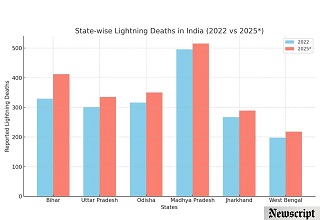
In just six weeks between March and mid-April 2025, 162 people died in lightning strikes across 12 states—a 184% rise over the same period in 2024.
Climate Science Has No Alibi
As the climate warms, the atmosphere holds more moisture—about 7% more for every 1°C of warming. That moisture feeds convection, the vertical surge that builds tall, cold, electrically active thunderclouds. The more water. The more cloud height. The more friction. The more lightning.
For every 1°C rise in global temperature, lightning strikes increase by approximately 12%. India is especially susceptible.
The Geography of Exposure
Lightning, though impartial in theory, tends to favor those without shelter. The dead are farmers and field workers, shepherds and brick-kiln laborers, children returning home from school. They are barefoot in the fields, roofing bamboo huts, standing by electric pumps. Their risk is not random. It is systemic.

Prevention Exists, But Elsewhere
The National Disaster Management Authority has had a lightning preparedness plan since 2019. It recommends:
– Lightning arrestors on public buildings
– Shelters within reach of fields
– Panchayat-level warning infrastructure
– Education campaigns using local media and folk art
– 30/30 rule training in schools and markets
Some states—Rajasthan, Odisha, Maharashtra—have implemented these recommendations. Others have not. West Bengal lacks a structured lightning action plan.
After the Strike
By 4 p.m., the sun had returned. The fields glistened. The birds resumed. And in eighteen homes, meals went cold.
Funerals were quiet. Compensation—₹2 lakh per victim—was announced before sunset. The lightning did what it always does: arrive fast, leave nothing to argue with, and retreat into silence. But what remains is measurable. Forecastable. Preventable. And it will return.