
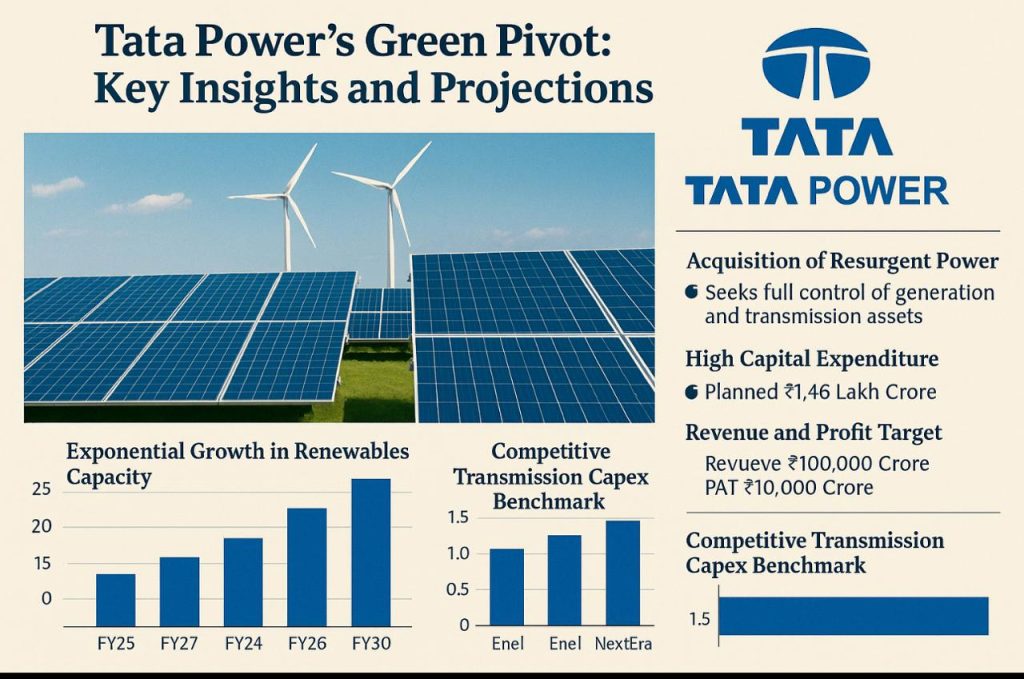
Mumbai, July 4, 2025: Tata Power is not simply transitioning to green energy—it is reconstructing its identity. What began as a cautious shift toward renewables has, over the past year, evolved into one of the most expansive energy transitions in Indian corporate history. Backed by a ₹1.46 lakh crore capital commitment, the Mumbai-headquartered utility is repositioning itself from a conventional generator of electricity into a vertically integrated green energy major, spanning generation, transmission, distribution, manufacturing, and storage.
The centrepiece of this pivot is a proposed $2.1 billion acquisition that would give Tata Power complete control over Resurgent Power Ventures, a Singapore-based platform with critical assets in generation and transmission. The company currently holds a 26% stake via its international arm, but is in advanced negotiations to acquire the remaining 74% held by ICICI Venture, Kuwait Investment Authority, and Oman Investment Authority.
“This isn’t just about buying assets—it’s about securing the grid,” said a senior Tata Power official involved in the discussions.
If the deal closes as expected, Tata Power will take control of the 1,980 MW Prayagraj thermal power project and critical high-voltage transmission lines—assets that may offer outsized influence as India modernizes over 12,000 circuit kilometres of grid infrastructure by 2030.
Tata Power Renewable Energy Ltd (TPREL), the company’s green energy arm, commissioned 752 MW of new solar capacity in Q1 FY26—a 112% rise year-on-year. Total green capacity now stands at 5.6 GW, with a year-end target of 7.3 GW and a roadmap to reach 23 GW by FY30.
“This is a multi-layered strategy. We’re not reacting to market sentiment—we’re building foundational infrastructure,” said a Tata Group board advisor.
The company’s largest partnerships are taking shape at the state level. In Andhra Pradesh, Tata Power has signed a ₹49,000 crore MoU to build up to 7,000 MW in solar and wind; in Assam, a ₹30,000 crore commitment will fund 5,000 MW of capacity over five years. Meanwhile, its synergy with Tata Motors has produced over 200 EV fast-charging stations and captive solar projects supplying 131 MW to manufacturing units.
In battery storage, Tata Power has tied up with ONGC to deploy utility-scale BESS systems. Its 4.3 GW solar cell and module plant in Tamil Nadu is expected to be operational by December 2025.
Financially, the company’s fundamentals remain strong. Revenue for FY25 reached ₹65,478 crore, and net profit rose to ₹4,775 crore. Yet with a P/E above 32 and 3.57x book value, expectations are clearly high.
But there are risks. The removal of transmission subsidies for renewables has raised project costs by ₹0.40/kWh. Land acquisition issues and delayed clearances continue to haunt large projects in Rajasthan and Madhya Pradesh.
An internal roadmap viewed by Newscript projects the following growth trajectory:
| Year | Renewable Capacity (GW) | PAT (₹ Cr) | Market Cap (₹ Cr, Est.) |
| FY26 | 7.3 | 5,500 | 1,40,000 |
| FY28 | 15 | 8,200 | 1,75,000 |
| FY30 | 23 | 10,000 | 2,25,000 |
“Execution discipline is everything now,” said a fund manager at a leading global ESG fund. “The strategy is world-class, but you don’t get two chances in this kind of capex cycle.”
Tata Power’s rooftop solar portfolio has also grown to over 2 GW, supported by a ₹2,800 crore order book. Its participation in the PM Surya Ghar Yojana could bring exponential growth if project clearances are expedited.
In the larger global context, Tata Power’s cost of green capacity addition ($580,000 per MW) remains competitive against peers such as Enel Green Power and China Three Gorges. Analysts say its bet on manufacturing, coupled with distribution expansion to 50 million consumers by FY30, could offer unparalleled scale.
The company’s strategy is not without its sceptics. “There’s concern that the capex cycle is front-loaded and margin accretive only by FY28,” an analyst at a domestic brokerage said.
Still, Tata Power’s ambition is unambiguous. With its hands on wires, watts, modules, and meters, the company may well emerge as India’s first true green utility giant.