
New redevelopment policy aims to modernise ageing housing, unlock land in core city sectors, and reposition Noida’s urban future
Noida has approved a transformative urban redevelopment policy that allows for the demolition and reconstruction of ageing residential complexes across the city, drawing from Mumbai’s landmark slum rehabilitation model but tailored to the region’s housing fabric.
Cleared at the Noida Authority’s 218th board meeting on June 14, the policy raises Floor Area Ratio (FAR) limits to enable vertical redevelopment, offering existing residents larger, modernised apartments at no cost, while granting developers additional saleable units. The initiative marks the city’s first formal attempt to address crumbling post-1980s housing blocks, many of which face structural risks.
“We have identified 4–5 buildings in a dilapidated state. When they were built, the FAR was 1.5; now it’s 3.5. We will float separate RFPs (requests for proposal) for each,” a senior Noida Authority official was quoted as saying.
Unlocking Central Noida’s Aging Core
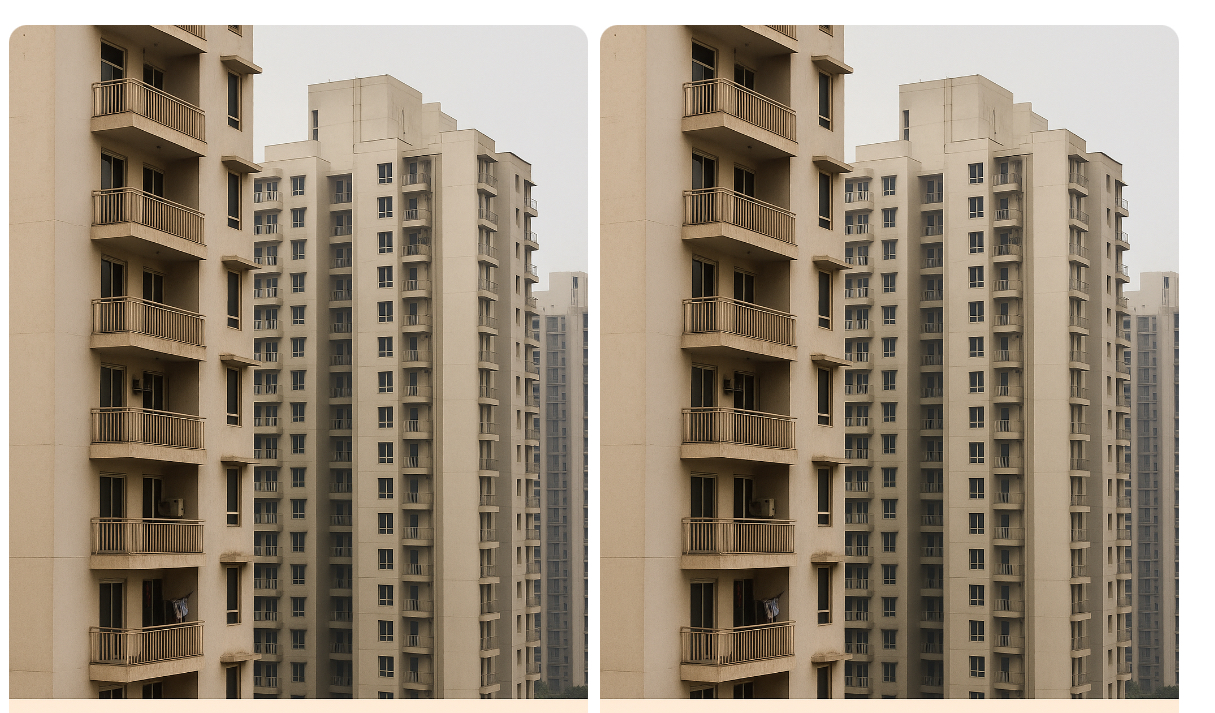
The new policy applies to group housing societies and EWS flats developed over 30 years ago, many of which have deteriorated due to poor structural upkeep. The Authority’s data shows over 115 private and Authority-built housing complexes are now vulnerable to leakage, concrete degradation, and safety lapses.
AOAs have typically focused on cosmetic repairs like painting, without commissioning safety audits or retrofitting. The new FAR relaxation—from 1.5–2.0 up to 2.75–3.5—will help rejuvenate these buildings through public-private partnerships, with homeowners receiving at least 15% more carpet area in newly built towers.
Redevelopment will initially cover complexes in Sectors 27, 52, 93, and 93A, including notable projects like Mansarovar and Shatabdi Vihar, which sit on highly sought-after land parcels but are fast aging into obsolescence.
Three-Pronged Strategy for Housing Categories
The policy classifies redevelopment into three categories:
-
Authority-constructed flats – RFP-based competitive bidding.
-
Cooperative housing societies – Residents select developers, subject to Authority vetting.
-
Private builder projects – Can apply for voluntary redevelopment.
All developers must register under RERA, maintain timelines, and meet quality standards. Crucially, they are barred from marketing or selling new units until the upgraded homes are delivered to original owners.
“Residents will not be asked to vacate their homes unless relocation arrangements are made,” states the policy document. “Sales can only begin after the upgraded flats are handed over.”
Developers are also responsible for interim housing or monthly rent payments to displaced homeowners during the construction phase.
Industry Response and Incentives
The policy has drawn interest from the real estate sector, albeit cautiously.
“This is a much-needed policy that opens up land in central Noida. But each project must make commercial sense. Buyer expectations have shifted,” said Nikhil Hawelia, MD of Hawelia Group and Secretary, CREDAI Western UP.
To incentivise top-tier builders, the Authority is offering waivers on stamp duty, lease rent, and streamlined project approvals. Developers with a history of delays or poor-quality delivery risk being blacklisted.
The Authority will also set up a grievance redressal cell to manage complaints and penalise FAR misuse or short delivery of carpet area.
National Benchmarking and Urban Strategy
Noida’s policy is the first major replication of Mumbai’s 1990s SRA (Slum Rehabilitation Authority) model in the NCR region. While Mumbai pioneered the use of FAR and Transferable Development Rights (TDR) for inner-city renewal, Delhi’s Master Plan 2021 only proposes FAR incentives for transit-oriented development, lacking any large-scale urban renewal structure.
Urban development experts point to Ahmedabad and Hyderabad using TDRs selectively, but not at the systemic level that Noida’s plan proposes.
If successful, the Noida model could become a template for Gurgaon, Faridabad, and Ghaziabad, where ageing housing and informal settlements remain unaddressed by policy.
The Road Ahead
Implementation will depend on three critical levers: developer participation, resident consent, and regulatory efficiency.
The Authority will release project-specific RFPs, enabling tailored timelines and architectural designs. A single-window approval system is being introduced to fast-track clearances and rental reimbursements.
Despite high stakes and complex stakeholder dynamics, the Authority is betting on this scheme to rejuvenate the city’s housing backbone and reshape Noida’s built environment for decades to come.
“This is Noida’s boldest housing reform yet. If it succeeds, it will change how cities think about ageing infrastructure,” said a policy insider.
For Advertisement and editorial inputs Please contact : info@newscript.co.in