
19TH OCTOBER, 2025
The debate over protectionism and predatory pricing, very often, lack rationale and logic. The noise and indignation against invasion of domestic market place by foreign predators cannot camouflage the truth. Consumers, and , end users prefer qualitative and durable products – indigenous or imported – at affordable prices. The demand for imported or foreign products reflects the deficiencies in indigenous products and their incompatibility with the competitive environment. Believe it or not, China is playing a crucial role in India’s solar energy evolution and revolution. Perhaps, this can be construed as ridiculous and incredible, but the solar success story can be attributed to so-called predatory pricing by China.
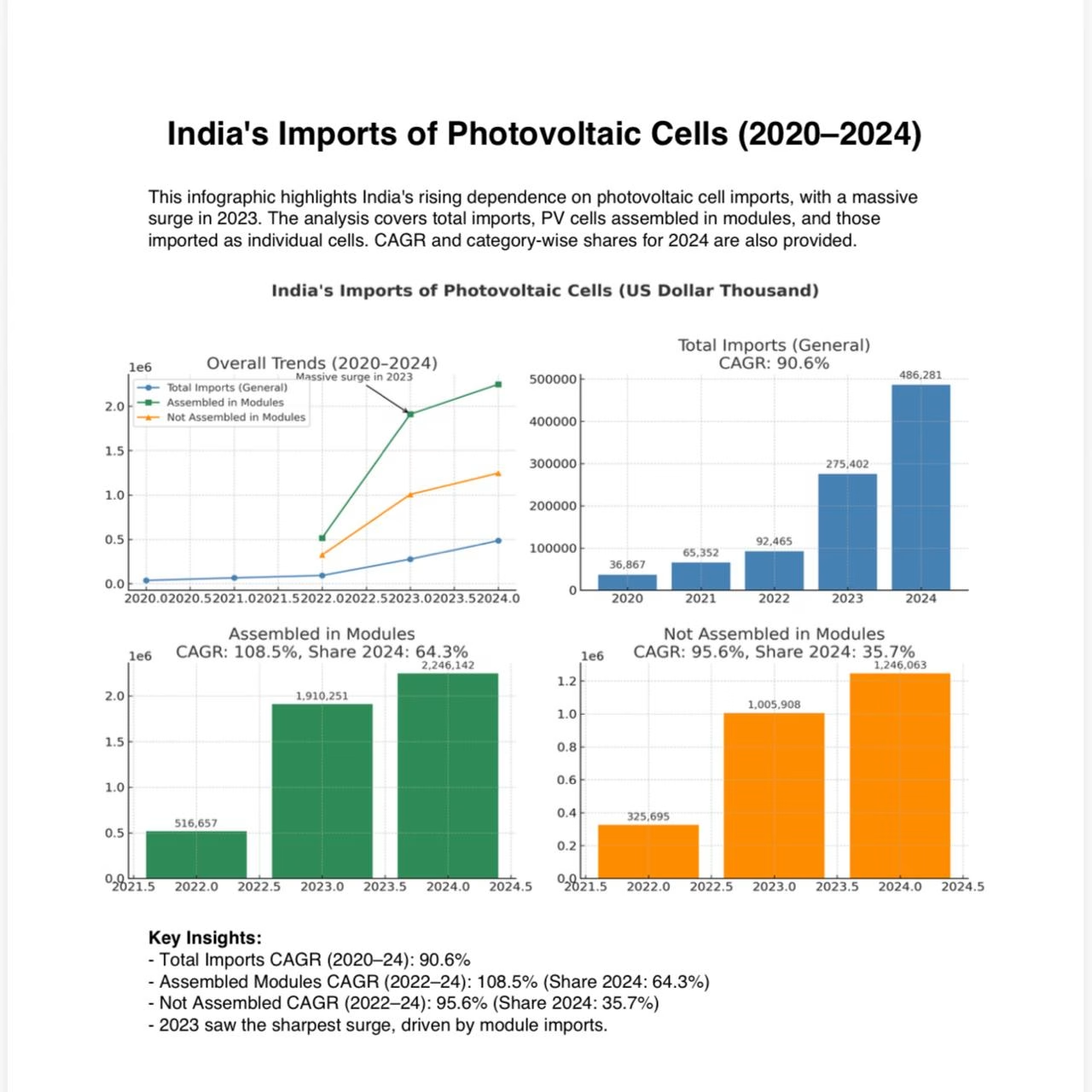
India ‘s imports of of toughened tempered glass – a major component of solar panels – from China has increased by over ten times from $36 million in 2020 to around $486 million. The imports also recorded maximum procurement by over near five times during the three-year period 2022-2024 from nearly $92 million to around $486 million . China’s share in India’s global procurement of this product ranged between 44% in 2022 to 91% in 2024 which is in tandem with spurt in India’s solar sector growth during this period. India’s imports of other solar module components – i.e. Photovoltaic cells assembled in modules, and, Photovoltaic cells not assembled in modules or made up into panels increased four time from over $500 million to $ over $2billion, and, from $300 billion billion to over $1billion. The figures indicates a substantive linkage between Chinese imports and India’s solar progression. It also reflects the China’s crucial contribution in India’s solar energy growth story .And, ironically, protectionism has proved to be a roadblock to the solar sector’s strides towards capitalising on its immense potential. India is equipped with the third highest solar power capacity, in the world. The sector has recorded a quantum leap during 2022-24, , and, according to latest reports, the country’s total solar capacity was at 119.02 GW. Solar energy accounts for 22 per cent of India total installed power generation capacity and 48 percent of total installed renewable power capacity.
It is an incredible achievement, considering the fact that the solar sector had achieved this milestone, despite the counterproductive impact of the anti-dumping duties against its imports from China. But, the success has a huge price tag attached in the form of duties which will ultimately impact the consumers. Today, India is paying too high a price for green and clean energy. SWOT analysis indicates that solar energy sector’s progress from strength to strength towards a green and sustainable future, is being debilitated by irrational duties.
———————————————————————————————————–
INFOGRAPHICS
The Author is the Associate Editor of Newscript Energy World.