Tag: Energy Policy

NTPC and Adani Power highlight competing models in electricity
Power

NTPC and Adani Power highlight competing models in electricity

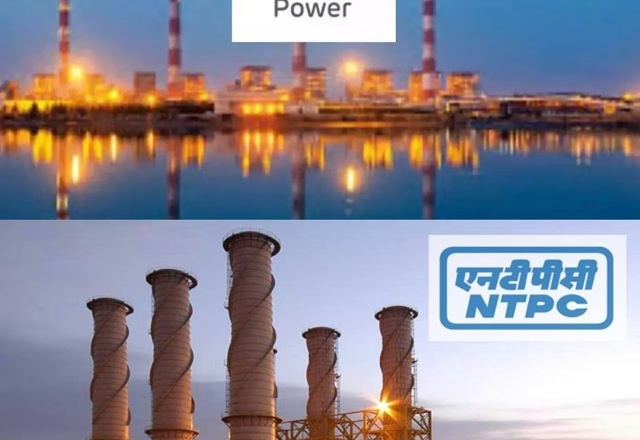
India’s electricity sector is witnessing a contest between state-owned NTPC and private rival Adani Power, with scale pitched against efficiency. NTPC remains the dominant generator, producing 439bn units last year from 80GW of installed capacity. The company mines coal from nine blocks and operates thermal, solar and hydro assets. It plans to add 30GW of nuclear capacity, cementing its role as the country’s energy backbone. Adani Power, while smaller, outshines on profitability. It produced 96bn units but posted a 37.9 per cent operating margin, compared with NTPC’s 28.77 per cent. Return on equity was 25.6 per cent, almost double NTPC’s 13.6 per cent. The contrast stems from approach. Adani sells nearly 90 per cent of its output under long-term contracts, securing stable revenue...

PREDATORS SCRIPT INDIA’S SOLAR GROWTH STORY
Renewables

PREDATORS SCRIPT INDIA’S SOLAR GROWTH STORY

19TH OCTOBER, 2025 The debate over protectionism and predatory pricing, very often, lack rationale and logic.  The noise and indignation against  invasion of domestic market place by foreign predators  cannot camouflage the truth.    Consumers, and , end users  prefer qualitative  and durable products  -  indigenous or imported  - at affordable prices. The demand for imported or foreign products  reflects the deficiencies in indigenous products and their incompatibility with the competitive environment. Believe it or not,  China is playing a crucial role in India's solar energy evolution and revolution. Perhaps, this can be construed as ridiculous and incredible, but the solar success story can be attributed to so-called predatory pricing by China. India 's imports of of toughened te...
L&T and the Case for Private Nuclear Participation
Corporate Watch, News Update

L&T and the Case for Private Nuclear Participation

Larsen & Toubro’s chairman has called for private sector participation across India’s nuclear value chain, from mining to fuel processing and plant construction. The statement has reignited debate on whether India’s atomic energy ambitions can be met without loosening the state’s monopoly. India’s current nuclear capacity remains modest at 8.7GW, far below targets. Projects have long suffered delays due to financing, technology lock-ins, and limited public sector capacity. By contrast, global leaders like EDF, Rosatom, and KEPCO rely heavily on private contractors for scale and efficiency. L&T, with decades of engineering experience, argues that excluding private firms is stifling innovation and slowing execution. The appeal comes as NTPC has partnered NPCIL for a new project...
Social Media Auto Publish Powered By : XYZScripts.com