
Saturday, April 18

Tag: India Energy

Weekly Energy Brief : September 1- September 7
Environmental Accountability, Geopolitics, News Update, Oil & Gas Industry, Renewables

Weekly Energy Brief : September 1- September 7

EXECUTIVE SUMMARY India’s energy system showed resilience amid geopolitical stress. The U.S. 50% tariff shock was offset by Russia’s ~$7/bbl discount, sustaining flows through a ~6 mb/d shadow market while the Indian crude basket hovered near $70.71/bbl; pump prices in Delhi stayed broadly steady. Policy tailwinds accelerated the transition: ALMM List-II became mandatory for solar tenders, and a forthcoming GST reset cuts rates on renewable components to 5% while lifting coal/lignite to 18%, sharpening clean-power economics. Renewables reached 237 GW, with H1-2025 clean generation at ~236 TWh (+20% y/y); domestic module capacity now exceeds 100 GW. Corporates advanced green hydrogen, storage, and ammonia projects, as regulators tightened ESG: SEBI’s value-chain reporting is voluntary in ...
Gulf Suppliers Cut Crude Sales to Russian-Backed Indian Refiner
Oil & Gas Industry

Gulf Suppliers Cut Crude Sales to Russian-Backed Indian Refiner

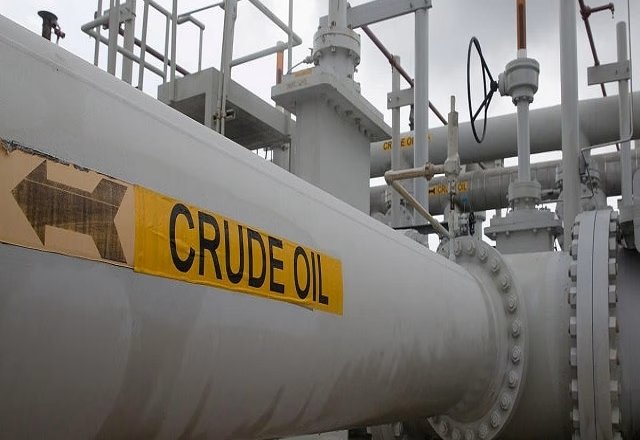
India’s Nayara Energy has cut refinery operations to 70-80% capacity after Saudi Aramco and Iraq’s state oil company SOMO suspended crude supplies following European Union sanctions targeting the Russian-backed facility. The 400,000 barrel-per-day Vadinar refinery, majority-owned by Rosneft, has lost its traditional 3 million barrels monthly from Gulf suppliers and now relies entirely on Russian crude. The supply halt follows EU sanctions imposed in July as part of the bloc’s 18th sanctions package against Russian energy assets. Saudi Aramco and SOMO suspended deliveries to avoid sanctions exposure, severing established commercial relationships with one of India’s largest private refiners. The final Saudi shipment of Arab Light crude arrived July 18 aboard the VLCC Georgios, while th...
ONGC JOINED HANDS WITH TATA POWER RENEWABLES TO DEVELOP BATTERY STORAGE
Oil & Gas Industry

ONGC JOINED HANDS WITH TATA POWER RENEWABLES TO DEVELOP BATTERY STORAGE

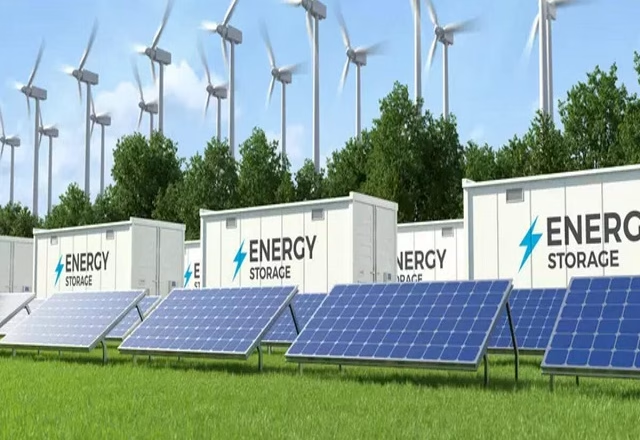
Tata Power Renewable Energy and Oil and Natural Gas Corporation have joined forces to develop large-scale battery storage, marking a decisive step by India’s biggest oil producer into clean energy. The agreement was signed at India Energy Week in February, as ONGC faces growing pressure to reduce dependence on fossil fuels. Chairman Arun Kumar Singh said energy storage was vital to stabilise the grid as more solar and wind capacity comes online. ONGC has set a goal of 10GW of renewable power by 2030 and pledged net zero emissions by 2038. Tata Power adds operational know-how. It runs India’s largest solar-battery plant, a 100MW facility with 120MWh of storage in Chhattisgarh. Chief executive Deepesh Nanda said the partnership would scale solutions across utilities, industrial consume...
Reliance bets big on green hydrogen with new Gujarat complex
Renewables

Reliance bets big on green hydrogen with new Gujarat complex

Reliance Industries is moving ahead with construction of a green hydrogen complex in Jamnagar, Gujarat, positioning itself at the centre of India’s nascent hydrogen economy. The $10bn project, announced by chairman Mukesh Ambani, will anchor Reliance’s broader push into renewable fuels. It will integrate solar and wind capacity with electrolyser technology to produce green hydrogen at scale, with first output targeted for 2027. India has set a goal of producing 5m tonnes of green hydrogen annually by 2030 as part of its clean energy transition. Reliance intends to supply both domestic industry and export markets in Europe and Asia, where demand is growing under net-zero mandates. The Jamnagar complex will also manufacture electrolysers and advanced fuel cells. Reliance executives ...
India’s Offshore Gamble: ONGC, Reliance and BP Unite in Saurashtra
Oil & Gas Industry

India’s Offshore Gamble: ONGC, Reliance and BP Unite in Saurashtra

India’s growing dependence on imported crude oil has become a defining challenge for its economy. The country now imports nearly 85% of its oil requirements, creating a $220bn annual burden. Against this backdrop, three very different players — ONGC (Oil and Natural Gas Corporation), Reliance Industries Ltd (RIL) and BP Exploration — have joined forces in a new consortium to explore the Saurashtra basin offshore block. The partnership, under the government’s Open Acreage Licensing Policy (OALP-IX), will focus on Block GS-OSHP-2022/2 off the coast of Gujarat. ONGC will serve as the operator with a 40 per cent stake, while Reliance and BP each hold 30 per cent. The project has been billed by the Ministry of Petroleum as a strategic collaboration to enhance India’s energy security. Join...
Torrent Power: Gorakhpur Hydrogen Plant Marks New Phase
News Update, Renewables

Torrent Power: Gorakhpur Hydrogen Plant Marks New Phase

By Special Correspondent  Newscript, August 18, 2025  Torrent Power, traditionally known for distribution and generation in Gujarat, has made a significant leap into green hydrogen. The company recently inaugurated a green hydrogen plant in Gorakhpur, Uttar Pradesh—one of the first industrial-scale private sector facilities of its kind in India. The plant, designed to supply hydrogen for industrial use and mobility, signals Torrent’s recognition that utilities cannot rely solely on fossil-heavy grids. By investing in green hydrogen early, Torrent aims to capture emerging demand in steel, fertilisers, and transport. “Hydrogen is no longer a distant bet; it’s a strategic hedge,” noted an industry consultant. Torrent’s entry into hydrogen differentiates it from peers like Tata Pow...
India Energy News
News Update

India Energy News

By Team Newscript, August 14, 2025 Thermal and Renewable Power: AUSC Coal Projects Hit Approval Roadblocks India’s ambitions to modernise its ageing coal fleet with advanced ultra-supercritical (AUSC) technology are running into bureaucratic delays. Announced in the Union Budget 2024–25, the projects were intended to replace over 130GW of coal capacity nearing 30 years of service. Industry executives say AUSC units, which operate at higher efficiency and lower emissions than conventional plants, are critical to meeting both energy security and climate commitments. However, multiple projects remain stuck awaiting environmental clearance and final techno-economic approvals. Developers warn that the cost of delay is twofold: rising maintenance bills for ageing units and a missed op...
Social Media Auto Publish Powered By : XYZScripts.com