
By SATYAPAL MENON
Newscript, August 15, 2025
Is India’s considerable reliance on coal for power generation an unavoidable necessity, despite its’ potential hazards? Most of the futuristic projections point to continued dependence on this fossil fuel for catering to major chunk of country’s electricity requirements. This is substantiated by estimates which indicate that coal consumption would cross the billion-ton mark in the not too distant future, from 895 million tons in 23-24. Presently, Coal-fired power plants account for 75% of electricity generation in the country. Though there is a possibility of decrease in the percentage by around 20% to an estimated 55% in 2030, it also reflects the fact that coal-fired power plants would continue to account for more than half of India’s electricity requirement over the next few years. The consumption is poised to double over the five-year period 2021-25.
India has the fifth largest coal reserve in the world – estimated at 3,21,481 million tons – with the power sector accounting for 60% of total consumption. Out of the total installed electricity generation capacity of a little over 485 GW, Coal-fired power plants (CFPPs) hold the largest share with 211 GW (47%), followed by renewable energy sources at 34%, hydro at 10%, gas at 5%, nuclear at 2%, lignite at 1%, and diesel at less than 1%.
The over-dependence also points to a very disturbing scenario, since coal-powered plants in India are major sources of carbon dioxide emissions – a major causative of global warming – toxic emissions, and, particulate pollutants including sulphur dioxide (SO2), nitrous oxide and mercury. Exposure to these toxicants can cause severe respiratory ailments including asthma, bronchitis in addition to cardio vascular and digestive tract problems. Emissions from Coal power plants are also instrumental in creating environment hazards which cause acid rains, damage agriculture crops and disrupt the ecosystem.
Multiple reasons are attributed to India’s coal power plants spewing pollutants. One among them is that Indian coal used by the power plants is of sub-standard quality which generates low productivity and high levels of polluting ash content . Second, technologies used by the power producers are obsolete which results in lower efficiency and high ash content. Indigenous coal needs to be amalgamated with Coking coal – a resource which is not available in India – to generate pollution-free and high energy efficiency. Power producers – with few exceptions – prefer solely indigenous coal because it is cheaper than producing power with a mix of imported coal.
Economic compulsions for ensuring electricity supply at affordable prices are considered as one of the major reasons for power producers’ propensity towards indigenous coal. The availability of humungous resources coupled with the fact that power should be supplied to consumers at affordable prices is also viewed as reasons for power producers opting for Indian coal. There are solutions to curb, control and minimize the sulphur dioxide in the raw flue gas. Flue gas comprises a mixture of gases produced by the burning of fuel or other materials in power stations and industrial plants. According to a report, China – which tops the world in coal-powered generation – has through stringent regulation and state-of-the-art flue gas treatment effectively reduced sulphur dioxide content in the flue gas by 75 percent. On the contrary, India’s sulphur-dioxide content has increased by more than 50 percent. Though Solar and wind sources are making great strides – and in fact reduced the dependence on coal to some extent – the big question is whether India is fated to adjust with this inevitability of exposure to the hazardous carbon dioxide and Sulphur – dioxide emissions from the power plants?
——————————-
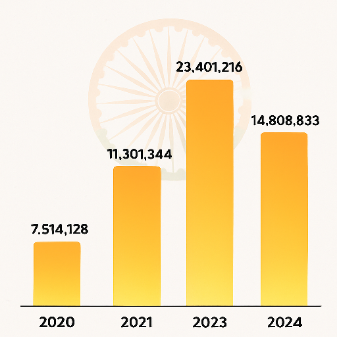
Non – Coking Coal Imports by India
2020 — 7,514,128
2021 — 11,301,344
2022 — 23,401,216
2023 ——17,265,181
2024 —–14,808,833
——————————
*** Imported non-coking coal is primary source for power generation in India
——————————