
In the dim fluorescence of ONGC’s war rooms, maps of basins curl over boardroom tables like parchment from a forgotten empire. Wells are planned. Rigs are deployed. Drills bite through time and sediment. What emerges, often, is silence—expensive, unyielding silence.
Over the past decade, ONGC has chased oil with the fervor of a state-sanctioned oracle. It has drilled across the western offshore, the depths of Krishna-Godavari, the quiet basins of Assam. It has spoken of sedimentary promise, of enhanced recovery, of integrated exploration. But between the seismic optimism and the actual production figures lies a trench of uncomfortable truth: ONGC has spent more money exploring than it has succeeded in discovering.
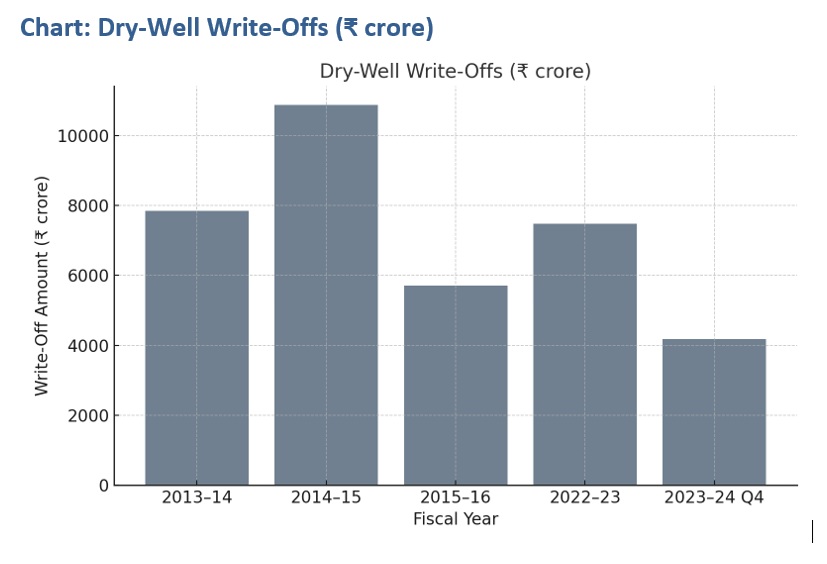
From 2013 to 2024, more than ₹70,000 crore has been written off in the name of exploratory ambition—dry wells that produced nothing but financial desolation. In the fourth quarter of FY 2023–24 alone, ONGC wrote off ₹4,173 crore and reported a 35% drop in profit. Still, it declared a record dividend—₹38,713 crore to its shareholders. It was a performance that could only have been celebrated by those who weren’t paying the bill.
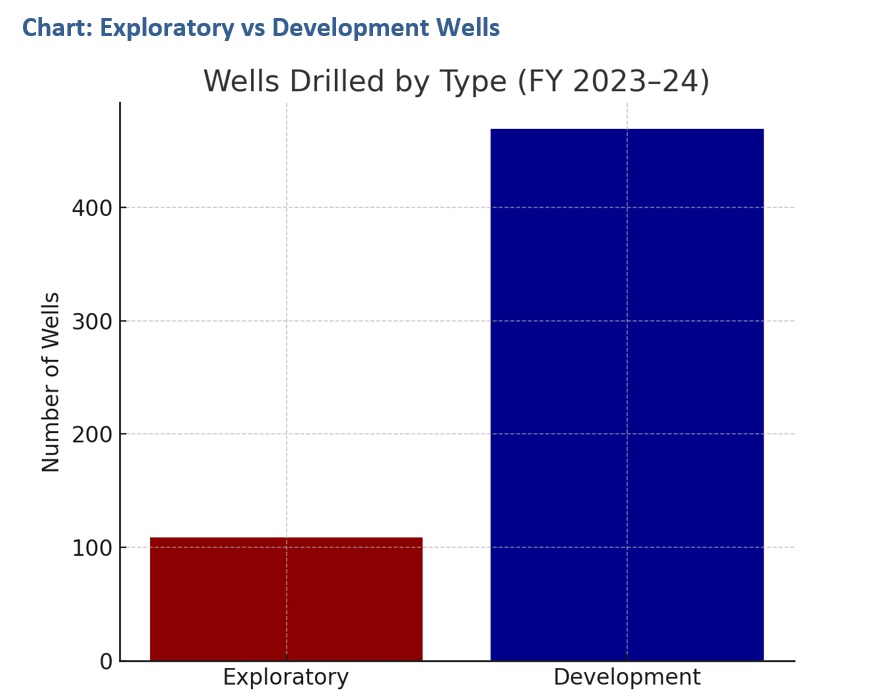
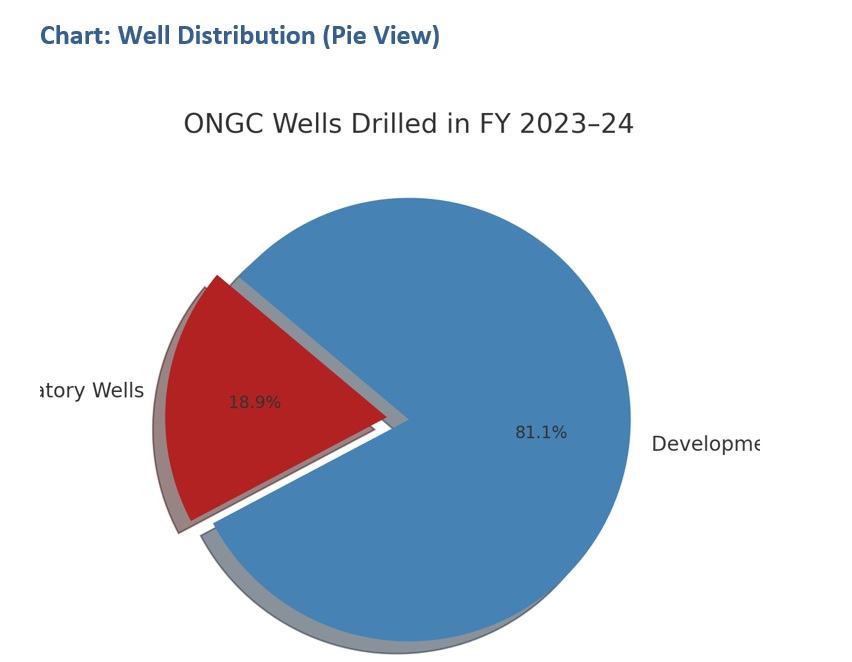
The figures in ONGC’s public filings are simultaneously voluminous and evasive. We are told how many wells are drilled—578 in FY 2023–24. We are not told how many failed. There is no cost per well. No annual reserve replacement ratio. No data on Enhanced Oil Recovery output. These are not footnotes lost in technical obscurity. They are deliberate omissions in a performance ledger funded by the Indian taxpayer.
In any boardroom where public capital meets commercial risk, there must be disclosure. In ONGC’s case, disclosure has become theatre. Press briefings speak of frontier breakthroughs. Social media narrates optimism. Meanwhile, the Directorate of Exploration, the body tasked with overseeing India’s energy future, continues to operate with the impunity of invisibility. Not one public audit. Not one top-level shake-up. Not one apology for the wells that came up empty—again and again and again.
It is not just that money was lost. It is that no lessons were recorded. The same hands turn the knobs. The same minds write the internal memos. Exploration, it appears, is no longer a matter of discovery but of bureaucratic continuity. There is no performance culture. There is only persistence without reflection.
A company cannot be punished for failing to find oil. But it must be held accountable for failing to measure why. ONGC has become a parable of what happens when strategy is unmoored from scrutiny. India cannot drill its way to energy security if its national explorer is afraid to report what it finds—or fails to find.
What ONGC owes this country is not just hydrocarbons. It owes clarity. It owes courage. It owes the integrity to publish the cost of failure alongside the press release of promise. Until it does, the drills will keep turning—not as tools of production, but as metaphors of denial.
After the Charts, the Reckoning
The charts and tables are not merely data—they are indictments. Line by line, they whisper what the press releases do not: that ONGC has lost more in missed wells than some explorers make in a decade. The wells are not the only thing dry. So too is the culture of accountability that should accompany a public enterprise spending public money.
No Directorate, no decision-maker, no senior official has stepped forward to explain how billions of rupees vanished into holes that never produced a barrel. India has paid for silence, subsidised opacity, and underwritten incompetence with taxpayer capital. The question is no longer whether the company erred. The question is who must now be held to account.
In any other corporate setting, in any other democracy, this pattern would trigger internal probes, shareholder class actions, even criminal investigations. But ONGC’s topography—both literal and bureaucratic—is shielded by layers of legacy and state patronage. A job is a posting, not a mandate. A loss is a line item, not a learning.
If corruption has played any role—and whispers abound—it must be excavated with the same rigor once reserved for geological surveys. India’s rule of law cannot allow a national energy enterprise to operate like a private fiefdom. The Ministry of Petroleum must act. The Ministry of Finance must audit. And Parliament must ask: who watched as this happened?
Because ONGC does not belong to its leadership. It belongs to the Indian people. Every rupee lost in a failed well is a rupee denied to a hospital, a school, a subsidy. Accountability is not vengeance. It is stewardship. And it is overdue.
This is the real extraction India needs now—not more oil, but more truth. Let the drills continue, yes—but let them be aimed first at the architecture of impunity.